Category Archives: Musings

The re-write is complete

Phew!

Now that was more an effort than I realised it would be.

I removed about 40,000 words from my manuscript over the past few months. That’s nearly a quarter of its weight!

Many of these were removed on a line-by-line edit: clarifying sentences, dealing death to adjective clusters, seeking out adverbs remorselessly and casting their brutally beaten bodies from my work. I did away with many dialogue tags. I found ways to say with ten words what I had said with twelve or fifteen. I found all of these little slivers of fat that still clung to the meat of my tale and I carved them off with a wicked sharp blade.

Then I had to really get stuck in.

This wasn’t my first pass with the scalpel, and on a project this size trimming fat didn’t shrink the manuscript by the requisite amount, so I started cutting away at the muscle, the flesh, in some cases the connective tissue. That hurt. I lost some good stuff I think. A character was erased from existence. Another had his role cut significantly. Two characters became so peripheral that to survive they had to undergo a melding of bodies and minds and become one. Details were lost, poignant moments, not-quite-salient anecdotes, slightly obscure back-story, geographical references, subtle foreshadowings… but these things ultimately were bloating the story into something more than what it should have been.

So now I have 131,000 words. Still big by the standards of a debut novel, but it’s a manageable big.

I asked a few agents (through the wonder of Twitter) what would be a maximum word-limit they would consider as a submission from an unpublished novelist and the answers were in the range of 140,000 to 150,000. I’m happily below that upper limit, and I’m sure the manuscript is much better for it.

I said at the outset that my goal here was not necessarily to become a professional writer, not even necessarily to become published, though both of those are measures of success. My goal is to become a better writer, and whatever comes as an outcome of this process I feel that the process has already achieved some success toward that goal. I made brutal decisions, but they were the right ones. Some years ago, perhaps even some months ago, I would have baulked those decisions, and I would have remained in a comfort zone of bloat and easy-living. That is not a good place for a writer to remain.

I also now have a much clearer delineation of writing and editing. When I was starting I would open the document and start editing the material I had just written the day before, and so writing was a crawl. I would write a couple of hundred words in a day, but then spend a day or two editing those before adding another couple of hundred and restarting the edit process. It’s a dysfunctional approach. It’s the wrong one. To borrow from Chuck Wendig:

“Writing is when we make the words. Editing is when we make the words not shitty.”

I believe I have done that. I believe my words are not shitty.

And now? Now I get the query letter dressed up. Now I nail that synopsis. Now I go back to Chapter One, Page One, Paragraph One, Word One. Now I make that opening irresistible. Because this week the queries go out (agents be warned) and I think I’ve got a good chance now of putting my best foot forward. That might or might not lead somewhere, but at least I’ll be stepping out knowing I’ve put the work in to make it possible.


The Festive Season

I’ve been a little quiet on the updates through December, it’s always a hectic time. My two young boys are desperate for it to be Christmas already, we hosted one side of the family for a big lunch, the usual end of the work year farewell had extra significance because I’ll be moving to a new day-job at a different place in 2013, so all those ‘real-life’ concerns took priority.

I was still writing, those following me on twitter would have seen the word-counts I was updating. The final edit is past Chapter 32. Looks like there’ll be between 45 and 50 Chapters in total. I’m under 140,000 words (currently 138,500) so that goal has been achieved. It may even be I close in on 130,000. The goal though is to have that done by end of Jan.

I’ve had some encouraging interest in the manuscript, I’ve seen increased engagement with what I’m doing through this website, through my Facebook page and through Twitter. I’ve really appreciated those of you who have taken the time to comment or like or share or RT. It’s a great incentive for me to keep going. Thank you all.

So Happy Holidays, Season’s Greetings, Merry Christmas, Happy Chanukah,  Joyous Kwanzaa, enjoy the solstice (winter or summer, as is most relevant to you). Fight through the commercial and find the kernel of purpose. Spend time with those close to you. Eat, drink, be merry. Celebrate the important things. Spare a thought, and maybe some time, for the less fortunate.

Do what works for you. I’ll be doing what works for me. I should be back with some thoughts on Magic, Cover-Art, Editing, Short Stories, Writer’s Craft and my generally amorphous musings sometime in the New Year.


Gender, History and Fantasy

This one’s a multi-headed beast, so bear with me.

I guess this has been percolating away since I read The Mary Sue article  exposing James Gunn’s misogyny and homphobia. I’ve gotta say it took a lot of the shine off the Guardians of the Galaxy announcement.

Then I became aware of The Hawkeye Initiative on Tumblr, which does a disturbingly good job of depicting the inherent problems with the portrayal of female superheroes (and villains) as objects posing sexily (in impractical outfits).

I’ve been trying to sort out my thoughts on the matter and apply them to the world of Fantasy Fiction… but then Tansy Raynor Roberts up and does a better job than I could have done in her blogpost picked up by Tor.com.

At the same time(ish) Cracked.com publishes Luke McKinney’s article about the ridiculousness of calling out fangirls.

So I’m left with little to say, having to follow in the footsteps of those who have said it so well already. But when has that ever stopped me having my say?

In my own work I thought I had drafted a strong female character. She was a POV character (in a novel with several POV characters) and she was smart and independent and strong. The reader would have known this because I attached these adjectives to her repeatedly. I did this while she was pushed through a narrative in which she showed almost no agency, made no meaningful decisions for herself, was considered (by a patriarchal culture) to be superfluous, and appeared in scenes where women discussed what men did. But she was sassy. And I did several times describe her as strong, independent and smart.

The reviews from my test-readers (and one in particular) forced me to sit back and look, really look, at what I had written for her. I didn’t like what I saw. So changes were made and I believe there has been much improvement. I have also given another character gender re-assignment, and this has been one of my personal favourite improvements in the rewriting.

Ellen Ripley was, in an early draft, a male. (S)He was to be the ship’s security officer (an obviously male role on the ship) and would probably have been cast by an athletic, muscled square jawed type, who would have killed the Alien and survived (with or without the grey panties – damn you Hawkeye! Must you ruin everything?) to fight another day. And the film wouldn’t have been terrible, but I doubt it would have been as good. It certainly wouldn’t have featured in articles in The Guardian celebrating the 30th anniversary of the ‘first action heroine’.
Why does Ripley endure so long after the two Alien films were made? (There were only two weren’t there – I’m pretty sure that’s right) I believe it’s because she wasn’t written as a gender stereotype. She’s a woman, but she’s not defined by that, and nor is she the pendulum reaction of Velasquez in Aliens (who is one of my favourite characters, but in many ways just a different stereotype).

The film Salt is forgettable (I’m not even sure I’ve seen the whole thing, I’ve seen bits), but it is interesting for the fact that the central character was written as a man. Tom Cruise was meant for the role, but withdrew because it was too close to his MI character of Ethan Hunt. At the same time Angelina Jolie was determined that she didn’t want to be a Bond girl – she wanted to be Bond. So a chance came up for her to be the action hero. Contracts were signed, but the deadlines were looming and there wasn’t time for a full re-write. They started shooting with the script for a male Salt and a few shifted pronouns (they did manage to take Salt’s children away from him/her – because while it’s ok for a father to risk his life as a CIA Agent fighting Russians a mother would never do such a thing – so it’s not perfect). The outcome is a film in which the character is played by a female, but not saddled with the gender stereotypes that are written for Strong Female Protagonists. (and some confusing scenes where a rake thin Angelina overpowers goons with brute force).

I met Tansy RR at Genrecon recently (in the sense that I nervously said hello once or twice and joined in a conversation with about ten people – of which she was one). Her take on history is fantastic – and backed up by an impressive academic resume. If history is sexist, so be it. That doesn’t mean there wasn’t stories in which women played important roles. Hell, that doesn’t mean there weren’t women playing important roles in every story. It just means they were ignored. To take that fact and use it to justify continuing to ignore them is reflexive… and just straight-up dumb.

But even if we take patriarchal history as a basis, why should that apply to Fantasy? When Joe Abercrombie spoke at Genrecon he described his work as ‘Realistic Fantasy’ and admitted the concept sounded silly. I was relieved – I’ve been trying to define my own writing for some time now and I kept coming back to ‘Realistic Fantasy’ and getting caught in the oxymoron. The point is that as realistic as we want it to be its still our world to build. If Joe can be inspired by history and then have a character using magic spells to defeat his enemies then why is having a powerful woman going to break the story. How could a reader complain that women have too prominent a role on the basis of history, and yet happily accept the wizards?

And don’t think it doesn’t happen. Some readers make this complaint. It’s ignorant on two counts:

1. History is full of women doing cool stuff that could be the basis of Fantasy novels.

I’ll skip Cleopatra and move straight on to Lucretia, Cornelia, Vibia Sabina, Boadicea, Eleanor of Aquitaine, Empress Theodora, Catherine II of Russia, Queen Elizabeth the First! – and that’s just Western Europe. A quick googling will open up possible tales inspired by Hatshpsut (a female Pharaoh) or Empress Wu Zetian. Hell, tell Penelope’s story. Sure she’s just waiting at home for Odysseus, entertaining courtiers, but surely there’s an interesting tale to be told there. Tell the story of Queen Gorgo – just not one where she gets boned by Jimmy McNulty.

2. It’s Fantasy.

History might have cast women in certain roles, but the history of my fictional world has not – or more accurately it has cast them in different roles. And even if it’s a misogynist fictional world with a patriarchal hegemony, good fiction will come from the conflict of putting a powerful woman in there. How will she cope? How will society cope? What cracks will emerge? What conflicts? Will she be defeated? Forced into submission? Will the power structures shift, compromise? Will she inspire a revolution? This is what drives narrative. This is what makes it a fictional story worth the reading.

I’ll leave the last word to Scott Lynch, who here responds to complaints about one of the female characters in his second ‘Gentleman Bastard’ novel Red Seas under Red Skies.

Comment, criticise, condemn, condone, as you will.

Or debate me face-to-digital-face / pat my back on twitter @jmichaelmelican

The continuing importance of editing

I’m under 150,000 words now on the continuing project to bring my manuscript down to a publishable size. Given that the upper limits (especially for an unpublished author) are in the 130 – 140k range I still have some work ahead of me, but I feel it’s going well.

Most of the words cut so far came from some major changes:

I cut a character. In one sense he was minor, but I had a plan to develop him much further later in the story. When some of that got chopped he became even less significant in his earlier scenes, and so, brutally, I cut him. Not an early death… he never existed.

I have restructured the opening chapters. Originally they were all weighing in between 3 and 4 thousand words and most had more than one narrative POV, so I changed the structure of the chapters to have each be a single narrative POV. They’re shorter, punchier and arranged so that there is a more logical flow. I think it has done wonders for my pacing and has  also removed the last vestiges of their being a really clear dominant POV character, so that now several POV characters each progress the narrative and each give us insights into the events from their own perspective.

I also restructured the plot in the opening, partly to facilitate the narrative changes, and partly to streamline the plot. In one chapter in particular the various changes I had made over time had caused a great deal of confusion. This chapter was (and is) a crucial nexus for the characters and I think it now does a better job of drawing the threads together and scattering them, where before it just drew them in and left me with an ugly tangled mess.

So the process is a positive one. I have lost a lot of words to the cutting-room floor and many of these I believe were quite good ones. I’ve lost scenes I liked, because they no longer were needed, or no longer made sense. I’ve lost some nice prose, some sharp dialogue, some insights into the characters and how they maintain themselves in the world… but in return I’ve got a leaner, fitter plot, I have thinned out some of the exposition chunks into a nice exposition stew (there’s a better metaphor for that I’m sure. Perhaps I’m hungry? Certainly I’m tired).

So I need to cut at least another 10,000 or so, possible 15,000, and I’ve made the major changes. I’m back to the start and going through, chapter by chapter, finding superfluity and error. It’s difficult and at times tedious, but it’s necessary and ultimately a very positive thing. Today I cut 750 words from a chapter. That’s probably a higher than average edit.

If I can cut 500 words from every chapter by this process I’ll get to the end of the book having carved out another 17,000 words or so, and I’ll be right on target!


Genrecon Australia 2012

Last weekend I went to the inaugural Australian Genrecon and I have to say WOW! What an excellent decision that was. Yay me!

Of course the real congratulations should go to the likes of Peter M BallMeg Vann, and the ninja team from Queensland Writers’ Centre. What a magnificent event they organised and managed!

This was my first ever convention, and I have to admit I had no real idea what to expect (or what I was doing). I read a few tips. Chuck Wendig’s were pretty helpful. A lot of common sense of course but a good guide nonetheless. (He was also quoted in a panel by P M Newton: ‘Plot is Soylent Green’)

The other massive help was Twitter. I was flying basically solo… I knew a couple of people from online interactions, but only one person I’d met face-to-face. So when I walked in to the opening function on Friday night it was a massive relief to start recognising some twitter handles on name tags.

One face I did recognise was International guest of honour Joe Abercrombie. He was surrounded, and congenial and charming and gracious and relaxed and just a wonderful international guest. Full credit to him.

I managed to spark up a chat with Ginger Clark, about whom I knew enough from twitter to give me some icebreakers. We discussed zoos and Australian fauna and Sandy and suddenly the crushing weight of Curtis Brown NY was lifted a little. She’s really a nice person and I had a lot less fear for my Sunday pitch.

The adults only panel was excellent. Good natured and great fun. I worried that I had made a fool of myself in a discussion of the C-bomb, but everyone was great. I’d never considered the difficulty romance writers had choosing between descriptions which were either twee or coarse.

Afterwards I met some great Romance writers who were kind enough to explain to me some of the subtleties of their craft and how careers are forged from one’s writing. Thanks to Denise RossettiNikki LoganAnna Campbell and Alexis (sorry Alexis – I forgot your surname).

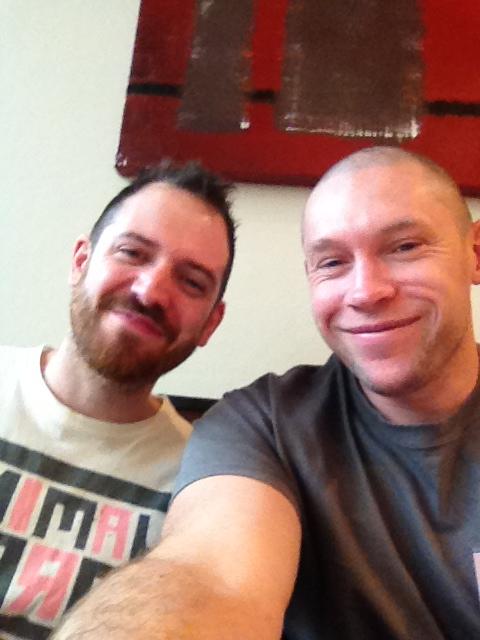
I’m on the right, with idiot grin!

Saturday morning was a great highlight. I was running a little late, stopped in for a quick toast and a take-away coffee with the intent of sneaking into a 9am seminar moments late, but Joe was alone at a table, enjoying a pretty good approximation of a full English brekky… what’s a fanboy to do?

Joe was great. We chatted like old pals for nearly an hour. Talked black pudding, Lancaster accents, kids, nappies, travel, Australiana, First Law, Red Country, westerns, my fledgling attempts at a career, Batman as vigilante and Superman as fascist. I got a photo in which I’m grinning like an idiot child on Christmas day.

That an author of his stature should be so welcoming and open, and for him to show such interest in what I was writing, was magnificent and I am so grateful!

The panels were universally excellent. Special mention goes to: Kim Wilkins and her impressive (to me especially) use of Old English; Crime author P M Newton for being so erudite and articulate in the face of Joe Abercrombie’s wise-cracking; Peter Ball and Alex Adsett for their insights into writing as a career; Ginger Clark for her excellent presentation on what an agent does (and how);  the Saturday night Snark from ‘Smart Bitch’ Sarah (Platypus of Doom, Gay Tarot Reading Vampire Were-Roos, Mr Darcy’s horrible secret…); the conversation with Joe Abercrombie (of course).

Thanks also to Peta Freestone and Amie Kaufman for helping me hone my pitch, and to Lindy Cameron of Clan Destine press for her encouraging feedback.

Thanks to everyone who made the weekend so wonderful (especially my wife, who looked after our two boys solo all weekend! How did I get so lucky to have such support?).

It ended with a successful pitch (with a caveat for length) to Ginger Clark and an invitation to submit pages. Could not have hoped for anything more!