Category Archives: Uncategorized

Review: City of Last Chances

City of Last Chances is the first book in Adrian Tchaikovsky‘s Tyrant Philosophers series, and was my first exposure to Tchaikovsky as an author. It is also the novel which prompted me to explore the rest of the series, and more of his works, and more of his ideas and thoughts on writing, and thus ultimately to the suggestion he made on Bluesky and elsewhere, that there was a small niche of similarly concerned works within Speculative Fiction for which City of Last Chances is an exemplar, and which he came to label Fantastical Realism.
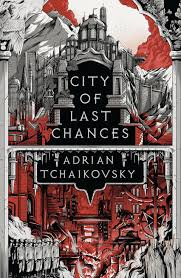
I have discussed here on this blog (and over on Bluesky) how my reading in recent months was shaped by exploring this suggested sub-sub-genre and the various examples Tchaikovsky gave in defining/describing it, and in coming weeks I’ll add more reviews of those knowledge, but the best place to start is right here where the whole project was inspired, on the gritty streets of Ilmar, the eponymous city, and among the various bureaucrats, soldiers, monks, demons, patriots, professors, conjurers, thieves and priests who inhabit those streets.

The spoiler-free review here is probably apparent in that it inspired a whole reading journey. This is right up my alley, and will likely be up your alley too, if your alley twists through semi-industrialised factories, crowded with magicians and mystics and thieves and beggars, with gods and ghosts hiding in the gutters.

Ilmar is a complex blend of magic and myth, politics and power, theology and technology. The city has been recently defeated/colonised/invaded by the powerful Palleseen, an empire which is motivated by the pursuit of ‘perfection’, and whose manner of that pursuit is the rigorous application of rules which dictate every aspect of daily life for the Ilmar residents. Among those residents are a formerly-ruling aristocracy clinging onto ceremonial and symbolic power by collaborating with the Palleseen; the collectivist labour movements of ‘Siblingries’ of workers who toil in the factories of the city; the students and lecturers of the ‘Gownhall’ who are trying to maintain their political and academic independence; the Allorwen refugees whose way of life was marginalised and mistrusted even before the arrival of this new colonial power; the organised criminal syndicates that control the underworld parts of the city which other powers cannot reach; and the last dregs of the beleagured and outlawed religions which were once dominant but have now been largely crushed in the name of ‘Perfection’. Perhaps most-strange of all, a grove of trees still standing in an ancient wood, the ‘Anchorwood’, within which will intermittently open a portal to other worlds, and by this grove a tavern, staffed by those who can facilitate travel and trade through this portal… for the right price.

Tcahikovsky gives us perspective characters from each of these groups, and often multiple charatcers within a group so that the internal divisions and disputes are revealed. It’s a complicated cast, and sometimes a complicated task for the reader to make sense of each perspective, especially when the same event is viewed so differently by different parties, but this complexity is a strength of the novel. It allows Tcahikovsky to gives us a detailed and thorough overview of the society in which these characters operate, along with an intimate and personal view of their challenges and troubles.

While there is no real protagonist, per se, it was Yasnic who remained the most central figure in my understanding of events. The last priest of a very minor God of healing (so minor that he has no other name than God), Yasnic is trapped in a very personal relationship with his cantakerous and demanding deity. Yasnic is not a figure of great power or influence, often not even a figure of significance, but he is a sympathetic character, a well-meaning man burdened by his oaths and obligations, and yet unable to set them aside. He provides a moral centre to the novel (albeit a resolutely deontological one), and because he moves through the city in a way that a more prominent or more public figure cannot, he becomes a narrative unifier, interacting with other characters in oblique ways and tying various narrative strands together, allowing the reader to gather the intricately knotted stories, untangle them slowly and weave them into something larger.

It is a character-driven novel, and it is in those characters that its greatest strengths are clear, but it is well crafted in many other ways as well. The writing is highly engaging, with some memorable quotes and phrases. The plot moves along at a good pace, rarely sagging, rarely rushed, some twists-and-turns which are to various degrees unpredictable. The mysteries presented are strange and intriguing and reach satisfying revelations. The world-building is careful and considered and highly detailed, both fantastical and plausible, filled with both novel imaginative wonders and familiar themes. The stakes ratchet up, actions have consequences, petty motivations derail grand plans, people’s faults and foibles can harm themselves and those around them even when motives are pure. Motives are not always pure.

With such a large cast and with so many plots and sub-plots running simultaneously you do sometimes find yourself in the view of one character when you’re keen to find out how another is progressing. The novel has a lot to say and each character provides us with a lens through which to examine some weighty themes: the brutality of colonial oppression, the resistance of the oppressed, the limits of unification in a hierarchical labour force, the effects of lost faith, the relentlessness of obligation, the costs of our commitments, the ways in which we are able to convince ourselves to do the things we feel we must do, the reasons we provide to ourselves when we are unable to do the things we cannot.

As more and more peices are added to the board, and as their connections complexify, and as each characters personal motivations come increasingly into conflict with others, it seems that it will be a difficult task to bring all of the ambitious threads together for the conclusion, it is finely done and Tchaikovsky sticks the landing.

So 5 Stars, from me.

I would highly recommend this novel, especially to any reader who enjoyed Mieville’s ‘Perdido Street Station’ or similar ‘New Weird’, or the kind of Fantasy which of more about an early-industrial era rather than the medieval, perhaps something like Abercrombie’s ‘Age of Madness’ series, or to those readers who are as interested in the political machinations of Fantasy worlds as they are in the magic and mythology of them.

Continuum 2019

*Blows dust off keys*
This thing on? It’s been a while.

Hey folks,

This weekend Continuum 15 gets underway, and this year Melbourne’s premier Spec-Fic con is also the NatCon with International Guests of Honour Kate Elliot and Ken Liu.

Once again, I’ll be attending and looking forward to a big weekend recharging the creative batteries. Unfortunately, only the Friday and Sunday this year.

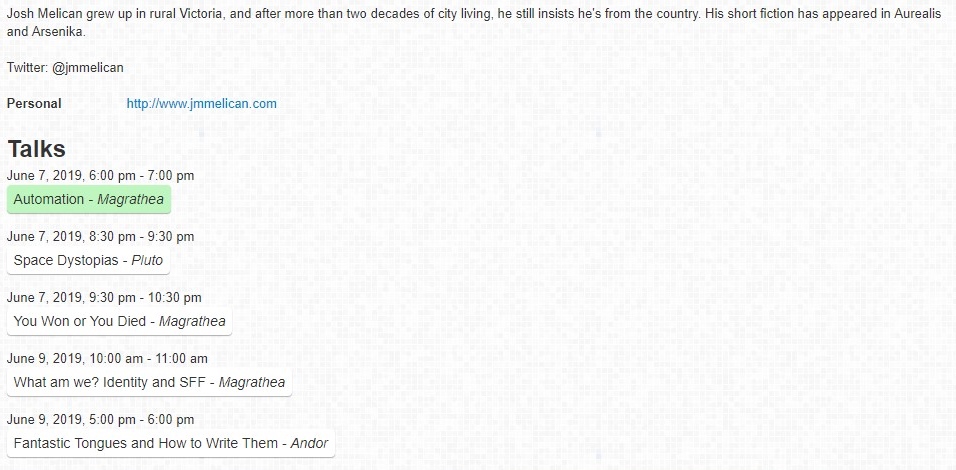
I’m on a few panels, so if you’re keen we’d love to have you come along and hear what I and others have to say about automation, space dystopias, fantasy languages, or Game of Thrones, or concepts of personal identity in SFF, and the various tangents and diversions those topics will inevitably lead to.

Here’s my panel schedule:

C15 schedule.jpg

I’ll also be around the convention generally, so if you want to come up for a chat, please do. If it’s your first con and you’re looking for someone safe to approach, say hi and I’ll do what I can to help make the con experience a good one.


Reflections on Continuum 2018

I have just wrapped up my first ever Continuum weekend.

I had a great time, caught up with some people I knew and got to know them better, met some new and interesting people, and sat in or on some fascinating panels about Speculative Fiction which catered to both craft and to fandom.

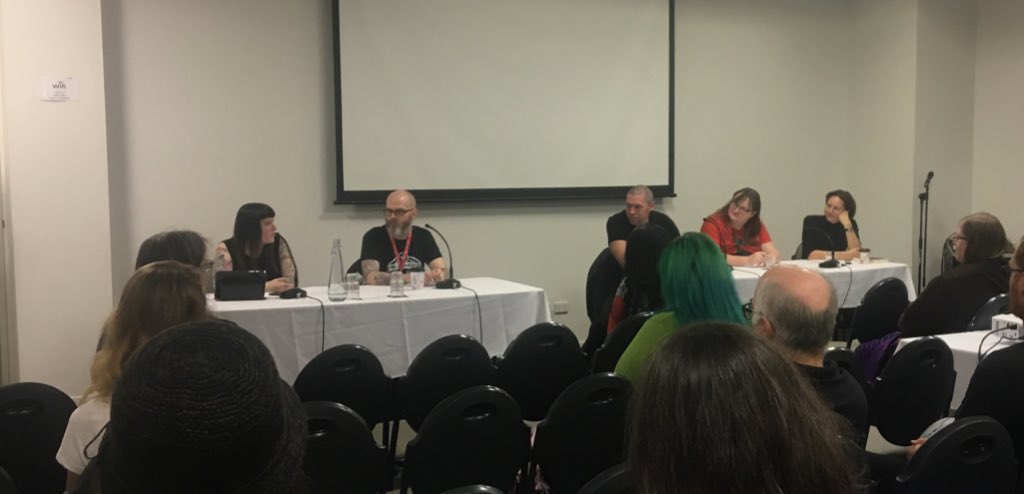
“This Panel is its own Grandfather”. A discussion of time travel, excellently moderated by Marlee-Jane Ward, and featuring (L-R) Corey J White, me, Darren/Lexie and Thalia Kalkipsakis.         Photo Credit to Sophie Y (@Smoph)

The con started with a real commitment to making itself a welcoming place to all comers. There were colour-coded pegs available so people could indicate whether they were actively seeking to meet new people, or if they preferred to avoid new social contact. The membership name-tags had a space to indicate your preferred pronouns and the toilets on one level were gender neutral. The con organisers made the code of conduct explicit and clear and gave people a variety of ways to report when con-goers might have violated that code. They had also deliberately tried to minimise waste, using digital rather than print wherever possible and ensuring that the name-tags were recyclable. I thought each of these little efforts went a long way to establishing the tone of the con.

Probably best that I leave it to others to judge the success of the panels I sat on, but for my part I really enjoyed The Good Place panel on Friday night, and filled the role of Chidi as best I could.  On Saturday the Speculative Ethics panel which I had proposed ran to a packed room and the immediate feedback from those in the audience who sought me out afterwards was very positive. Sunday’s time-travel panel was great fun and I learnt a lot about different kinds of time-travel stories which I’m adding to an ever-expanding reading list. On Monday I moderated the panel on Speculative Detectives, and got yet more reading recommendations and enjoyed the discussion about why detectives are so enduring in genre fiction.

My top-3 highlights as a guest:

I enjoyed the Zombie Politics panel discussion. Pete Aldin and Rjurik Davidson had some interesting perspectives on why audiences are so attracted to zombie fiction, and how the symbolism of zombies has changed over time. Julia (I’m sorry but I didn’t catch her surname) made a great point about the origins of zombies, their links to slavery, and what these stories have to say about our fear of losing agency of our own bodies. I was particularly interested in exploring how these undead figures might represent our political fears, and that’s probably something I will explore in more detail to come.

The panel on mental health in Spec Fic also had a lot of interesting things to say about how mental health conditions are represented in fiction, and the difference between good rep and damaging rep. As recent events continue to show us, mental health is a huge issue facing (in particular) the western world and I think it’s great to see efforts to remove some of the historical stigma and have a meaningful conversation about these conditions.

The Sunday night panel on Secondary Worlds Sans Magic was relevant to my own writing, and it was great to see other authors and readers exploring the concept of Fantasy stories which don’t have wizards and sorcerers and spells. The debate really centred around whether magic was essential to the Fantasy genre, or whether these magic-less world s were a different genre entirely. Mostly the panel agreed that non-magic worlds could still be Fantasy, but I was particularly interested how ‘magic’ could be defined. I wondered if N.K. Jemisin’s ‘Orogeny’ was magic, or China Mieville’s ‘thaumaturgy’. It is a well-known quote that ‘any sufficiently advanced technology is indistinguishable from magic’, but I wondered if perhaps the reverse was true: is any sufficiently well-studied magic indistinguishable from technology?

So overall, an excellent weekend and plenty within it to have fueled my creative fires. I added about 1,000 words to the WiP over the course of the weekend and I’m about to go back to it this evening and have another crack at it in earnest. I think it’s not too far away from beta-reader stage and I’m sure it will be better for incorporating some of the ideas and inspirations I’ve gotten out of the weekend.

Thanks to all the organisers, panelists and guests for making it such a great con.


Continuum 2018

This weekend I’ll be at my home-town Speculative Fiction Conference, Continuum. I’ll be in the audience for a whole lot of really interesting panels (you can see the whole program here) and probably throwing out a whole lot of tweets using the official hashtag #Con14 (this being the 14th Continuum Conference).

Continuum

I’ll also be on four panels, one each day:

Friday: Welcome! Everything is Fine
From 9:30pm Cecilia Quirk, Corey J. White, Natalie Haigh and I will be discussing The Good Place. We’ll explore comedy afterlives, ethics in popular fiction, moral philosophy and puns.
The good news here is that you can join in even if you’re not a member of the convention, as the Friday panels are open for people to come in and dip their toe in the water (for a small contribution. About $5 I think?)

Saturday: Speculative Ethics
From 3pm, Laura Wilkinson, Tania Walker, Sam Kiss and I will explore the connections between Spec Fic and questions of ethics and morality.
Whether this is the battle between good and evil on Pelennor Fields, the Prime Directive of the Federation, or T’Challa’s decision for the future of Wakanda, Fantasy and Science Fiction have often raised difficult questions about what it means to be good, the obligations we have to each other and the implications which arise from our moral beliefs. As readers and viewers, we make moral decisions about these stories: Who ought sit on the Iron Throne of Westeros? Should we be Team Cap or Team Iron Man? Can I justify post-apocalyptic murder?

Sunday: This Panel is its Own Grandfather
From 4pm, Corey J. White, Lexie (Darren), Marlee Jane Ward, Thalia Kalkipsakis and I will be talking about time travel: the good, the bad, the paradoxical. The works that exist, and the works that have not yet been released in this timestream.

Monday: Speculative Detectives
From 11am, I’ll be moderating the panel of Devin Jeyathurai, Kat CLay, Narrelle M. Harris, and Robert Hood
We’ll consider shows and books like the Expanse and Altered Carbon, where the cross-genre detective is making a comeback in a big way. Why is it so easy to mash-up the detective story with speculative fiction? And what makes a great genre-bending detective? These fans and authors discuss where these pulpy detectives come from, the best (and worst) stories and how to write one without falling into the trope traps of hardboiled PI meets femme fatale.

If you’re going to be at Continuum too I’d love to meet you. Come up and have a chat, especially if it’s your first Con. I’m always keen to meet people in the Speculative Fiction field and hopefully I can help people feel welcome and included in our shared interests.