Category Archives: Reviews

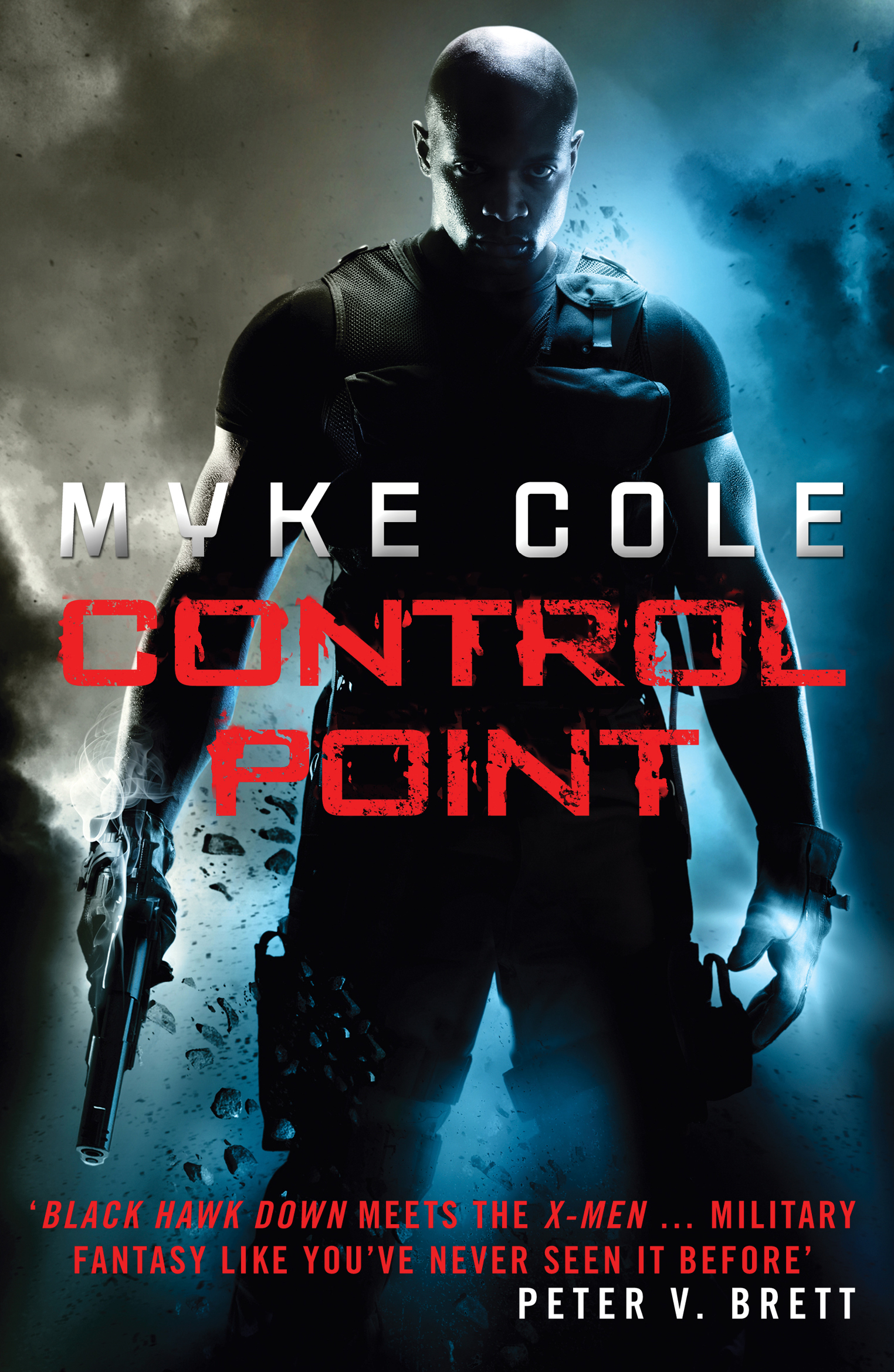
‘Control Point’ Review

Control Point Review

I’ll open with a spoiler-free (tl;dr) summary of my feelings about the book and then go into more detail (potential for some minor spoiling therein).

ControlPoint_UK_Cover_Final

Précis:

I enjoyed the book. I rated it on Goodreads, and although it deserves more than 3 stars, I don’t think I can give it 4.

I particularly enjoyed the way it challenged and questioned enculturated values. I liked how Cole managed the powers and his action scenes were kinetic and visceral. As a writer I learnt a lot from the way he brought the genres together, forced a collision and made something new from what was there.

I will read the others in the series, and happily recommend the book to fans of comic book superheroes, military fiction and urban fantasy.

Detail:

Control Point is the debut novel of Myke Cole, and the first in a series of “Shadow Ops” novels (of which there are three, with a prequel due out next year). I picked it up because I came to know of Myke Cole through his blog, and through Twitter (@MykeCole). He’s one of those authors who is incredibly interesting when they talk about how they came to be writers and what writing means to them. He offers advice and engages with his fan-base, and his books were recommended or enjoyed by others I trust, and had a good cross-over with other authors whose work I’d enjoyed (Mark Lawrence’s review is here: https://www.goodreads.com/review/show/246427711?book_show_action=true&page=1).

Cole is a US Military vet, having served in Iraq, and is currently a member of the US Coast Guard. It’s not a common résumé for Fantasy writers, and the world he has created is not common Fantasy. It has been described as a cross between ‘Black Hawk Down’ and ‘X-Men’ (by no less a reliable source than Peter V Brett), and you can definitely see the way that the influences of his professional militarism meet his personal geekdoms, with influences apparent from the battlefield, to superhero comics to D&D.

In an unspecified near-future USA there has been an awakening of previously latent powers. People have discovered that they can control elements, or – in rarer cases – exhibit other ‘magical’ powers. This awakening is quickly legislated and the military steps in to attempt control. Oscar Britton begins the novel as a military man charged with controlling (or killing) the awakened latents (selfers), but he sympathises with those he must hunt. When he exhibits powers himself he is faced with an impossible choice, to submit, or to flee.

Cole’s greatest strength is in his world-building. On gross structure this is familiar from any number of superhero origins, but it is in the minutiae that Cole’s world takes shape. Each chapter presents excerpts of speeches, legislation, media, etc from this new world which gives us a better insight into how society has sought to adjust. From this we can hold a mirror to modern cultures. The novel forces us to ask how we balance liberties against regulation, how we respond to de-centralised terrorism, how existing cultural and religious world-views have adapted – some better than others. The heavy-handed government control of the US is more criticised than endorsed. Cole takes an interest in the fictional indigenous of his magical source-world, and his understanding of Islamic and Native American cultures adds nuance and depth to what might otherwise have been a one-dimensional speculation.

That our protagonist finds himself more often opposing than endorsing his government’s militarist approach is particularly interesting, given Cole’s own history. If anything this is overplayed. The gung-ho militarists are obvious antagonists. Unfortunately Britton – our protagonist in this world, from whose perspective it is shown to us and to whose internal monologues we have access – is often a confused and confusing moral compass. Perhaps this puts the need to moralise back on the reader, something with which I am generally more comfortable, and yet the character suffers because of this uncertainty. From the beginning, when teenaged selfers are attacking their school, Britton sides with them over his command structures. This jarred me, as a reader, because the actions of the selfers were unsympathetic – they obviously needed to be stopped.

The pacing is rapid, the novel quite heavily plot-driven. This can mean that the prose is stark and direct, sometimes to the extent that it felt lacking. I think this is a necessary quality of the prose for the story being told, and this was a debut novel, but it makes no claims to high literature. This is fast-moving pulp and should be enjoyed as such.

Similarly, most characters are to be taken on face value, and while some show development and growth many others come into the narrative, serve their purpose, and depart the stage. Many remain archetypes or sketches throughout, and while this is a criticism, I think it’s one that flows inevitably from keeping the plot moving quickly. The character I found most sympathetic was the indig ‘Marty’, and he becomes a key motivation for the protagonist, as well as a key player himself in the build to the climax. Too often I confused characters, or forgot their names, or forgot which call-sign went with which name, etc. In large part this is my failing, but it also suggests perhaps that many of the secondary characters weren’t memorable beyond being a super-power in a uniform.

For Military/Fantasy/Sci-Fi with fast-paced action and a 2nd world twist this is a good series to get into.


‘Embassytown’ Review

Over on Goodreads I have a review in which I have tried to avoid spoilers. Here I go into more depth and there may be some minor spoilers for several of Miéville’s books, but I think I’ve largely avoided that again. Fairly warned though.

I am unashamedly a fan of China Miéville’s work. Look over to the tag cloud and you’ll see his name boldly prominent. I like to read his books, and I like to talk about his worlds and his writing.

Perdido St and The Scar were both magnificent. They changed the way I understood the Fantasy genre, my understanding of genre as a costruct, and what imagination and creativity really looked like. They opened shackles I’d unknowingly worn since my early-pubescent reading of Tolkein, Feist, et al. Fantasy was no longer the cobbling together of the D&D Monster manual. Fantasy was worlds drawn from a global supply of myth and eons of folklore and it was new things as well like physics and invention and theoretical sciences. The Fantasy hero could be a fat, middle-aged scientist, a bug-headed artist, a surgically enhanced man-dolphin. The Fantasy villain could be a moth, or a mayor, or some trans-dimensional benthic leviathan. That said, I’m not one of those calling for Miéville to return to Bas Lag. I am as interested in where he is headed as where he has been.

I liked Kraken and King Rat. I liked the London it showed me, familiar and strange at once, lovingly recreated and then twisted and shaped by myth and magic. I liked the subversions and inversions of ancient tales, of folklore, of nursery rhymes, of drum and bass. I liked the cross-culturalism of a modern city clashing with the ancient history of place. I liked the urban organic. I liked the religiosity and sociology of these ab-Londons.

Although some I know disliked The City & The City, I found it fascinating and I enjoyed the way that he drew back from what could have been absurdly fanciful and made it more about psychological dissonance, whether imposed or by way of self-discipline. I went away and researched towns with amorphous boundaries and cross/hatching. I developed a different understanding of geography and place. I found Iron Council to be a tough slog. At times it was frustratingly slow and tangential, but it had its rewards.

I was so looking forward to Embassytown: Miéville writing sci-fi, on an alien planet, with a whole alien race – a whole alien city – to create, with the technology for AI and constructs. Miéville exploring the artificiality of language, the interstice of translation, cross-cultural semiotics.

Miéville, sci-fi, linguistics.

What a recipe!

This should have been a book which I loved: brilliantly high-concept, detailed world-building, fascinating originality, clever and witty… and yet I really struggled to stick with it.

Embassytown is far from being a bad book. It is a very good book. Structurally it works well: builds a world, introduces us to characters, makes clear the complicated relationships and politics of people and place, twists and turns through an active plot and leads us to a satisfying conclusion.

I know that Miéville’s prose can alienate some readers, but I am not one such reader. His word-play, and his word creation, are fundamentally attractive aspects of his novels for me. In Embassytown we again have many of his signature phrases, his unique formations and phrasing, his extensive vocabulary, and I loved some of the passages. Miéville made me see the power of the adjective used adverbially when, in Perdido Street Station, a small seedling pushes pugilist through train tracks. It is a technique he continues to use to good effect. The Germanic origins of many of the terms gave depth to the world, but the hearkening to Latin and Greek gave variety. Neologisms of mashed nouns (terretech, citynaut, biopolis) were immediately sensible. The abbreviations (autom, exot, trunc) and others perhaps entirely invented (floaking – a term that has every right to join ‘Grok’ in the vocabulary of geekdom and perhaps beyond) fitted so naturally and seamlessly into sentences that it seemed that they just belonged. The numerator/denominator, cut/turn, expressions of the Hosts and the Ambassadors were a fascinating concept, as was the singular identity in dual physical bodies. I loved immersing myself (pun intended) in the language.

I also share an interest in many of the themes Miéville explored: metaphysics, existentialism, philology, the linguistics, the exploration of truly alien culture and the limitations on cross-cultural communication. The essence of self-hood, explored here through the ambassadors whose singular identity manifests in paired bodies, and names like CalVin and EzRa. The same theme I felt was sadly underexplored through the Automs – Artificial Intelligences whose personhood is hinted at but largely dismissed, most fully realised in Ehrsul. Of all the automs Ehrsul is said to be remarkable, even unique, and yet her narrative arc fades during the second act and is all but absent from the final.

Several characters annoyed me, but most notably Avice and Scile. This is perhaps because of the way the chapters inter-stitch different time periods, cross-hatching the Formerly and the Currently until the two narratives meet and we can finally progress to the finale. This makes Avice seem more inconsistent than she would be on a linear narrative, but even allowing for that I found many of her actions (and inactions) infuriating. Some of the tangents came to overwhelm and distract, there were Chekhov guns which remained loaded and mounted to the wall without ever being taken down or fired. Maybe – likely – this is deliberate. Likely Miéville is knowingly subverting such expectation, is touring us through the world he made so that we might simply enjoy it as an act of creation. He did the same in parts of Perdido, and Scar, and Iron Council, to varying success. He makes Embassytown more central than mere setting, just as New Crobuzon is, or London, or Beza/UlQuoma. To that end he is effective. The immerverse has massive scope for story-telling and an impressive depth beneath what little of it we see. Yet this efficacy comes at the cost of narrative pace and engagement, and for me there were times when the price paid was too great. The pace of the final act is effective, but for much of the middle it is glacial. Slow pace is not inherently a problem, but apparently it was a problem for me in this instance.

I gave Embassytown 3 stars on Goodreads, because for all that was good about it, I did not love it. More accurately, I loved it at times, in passages, intermittently. Other times it wearied me, it dragged, it rambled along and allowed me to follow without my ever really being clear why we were taking these detours. In sections, it floaked.

If you are a fan of China Miéville you should definitely read this. It follows through in detail and sophistication on many of the themes which are closest to his interest. If you are new to China Miéville, or unfamiliar with his brand of Weird / New Weird literature then I’d recommend starting with some of his others before working your way to Embassytown.


True Detective: masculinity, misogyny and monster myths

I have just finished watching True Detective and I intend to discuss it below in a way that will require I give a spoiler alert right here. There’s been a lot said recently about spoilers after a certain someone at a certain royal wedding met a certain fate and the internet went nuts and those people who didn’t want a 15 year old book spoiled for them were understandably upset. So though I don’t intend to deliberately spoil anyone’s enjoyment of True Detective, I’ll probably say something that might. Fair warning then. Spoilers ahead.

For a long time I have held The Wire to be my favourite TV show of all time, and I think there’s a fair stretch of daylight between The Wire and whatever is second. I thought Dexter was a challenger at around the time of Trinity, but it fell away quickly and it fell hard and by the end I hated that dead-beat, lumberjacking cop-out. Oz would be up there. I never quite caught the Breaking Bad addiction to the same extent as many friends did, but it’s clearly very good. Ditto Sopranos. Ditto Deadwood. Then there’s the next tier down where sits the likes of Lost, Walking Dead, first season of Heroes, etc.

True Detective I think is my new 2nd, and it’s closer to The Wire than any of those others came. It is the most stunningly beautiful cop procedural I have seen. The cinematography, the long-shots, the tracking shots, the aesthetic of landscape and urban decay and the people eking out lives of misery and quiet desperation… magnificent. Both leads are tremendous (and the support cast too, but more on that soon), each shed a weight of their parodied past and shouldered instead the gravitas and depth required in a series that relied a great deal on strong performances from its dual protagonists. They delivered. They delivered in spades. Harrelson is great, brooding, childish, petulant, aggressive, assured, fragile, by turns. He inhabits all of these contradictions and owns the physical changes Marty undergoes across the span of 15 years. McConaughey is astounding, and in his ’95 iteration particularly he is nearly unrecognisable but for his voice. I kept having to remind myself who I was watching, and he kept dragging me away from that guy and immersing me in the character.

That guy...

‘That guy’…

But what I feel truly set the series apart from other odd-couple, buddy cop, bromance, procedurals was the philosophical positions expounded by these characters. In his nihilism, his philosophical pessimism, his unflinching honesty-to-self, Rust Cohle brought some interesting ideas to the small screen. The most quoted – most quotable – of these has inspired Tumblrs and Sub-Reddits and all manner of internet discussion, dissection and debate. “Time is a flat circle” explores Nietzsche’s theory of infinite recursion – the thought that most terrified him, among all of the terrifying thoughts he offered. References to “The Yellow King” and “Carcosa” made an 1895 collection of short stories an Amazon best-seller.

Those whom I have read dissatisfied or critical of the series complain that after introducing this apparent profundity, this depth of philosophy and thought, this supernatural sense of myth… the finale is unconcerned with addressing those loose ends. I personally don’t think that was a problem. If this is to be understood as a story about Rust and Marty, then their story is told, and wrapped-up, in the finale. It is in some ways a surprising ending, perhaps in that it is so adherent to the buddy-cop formula, perhaps in that it draws a positive conclusion from a previously pessimist world-view, perhaps because it is so deliberately unconcerned with all those things that had the internet speculating, but it is a completion of the narrative.

Questions do abound though:
Who was the King in Yellow? Why was everyone so afraid? Why is the corpse of Errol’s father left just staked out like that? How did the murders go so long unrecognised? What was the role of the Tuttle family? What consequences await the governor? Why was this done in the first place? What religious or spiritual significance was attached to it? The spiral? The ability of DeWall to see Rust’s soul? What is the ‘mask’ Rust wears?

There’s been several articles and posts  about the conclusion. I can see why some feel the need for a more encompassing resolution to these questions, but I think that misunderstands the main theme of the show . This series was not entitled, “The Yellow King”. This was “True Detective”. Rust and Marty are our focus. It is their tale, and with the denouement in the hospital it is completed (although Lauren Davis’ examination of the conclusion as a supernatural victory for the Yellow King was most interesting).

The more complex criticism, and I suspect the more valid, is in the way True Detective treats women.
Kameron Hurley summarised the concerns as I understand them on her website, and her writing forced me to go back to the series and examine just how much I had read it through the lens of straight, white, cisgendered, male; examine just how different it might look through a different lens.

There were several occasions where the series explicitly explored the nature of masculinity. When, having seen only the first two episodes, I was asked by a friend what the series was about, “masculine roles” was my answer. In ep 2

Marty talks about how he differs from his father, how he faces his burdens – is expected to face is burdens – differently. He reveals himself as a man struggling to adapt to a world of shaken patriarchy. His concept of what it means to be a father, a husband, are shown to be hopelessly out-dated. Indeed he uses these concepts to rationalise the most egregious behaviour. His infidelities, he claims, are essential for him to maintain a healthy marriage. As the series progresses he loses control of himself, his family, his wife. The women in his life were all possessions, which he guarded jealously. His wife. His daughters. His mistress(es). He – as he tells Rust – likes to mow his own lawn. When these things are threatened he responds with violence, often shown to be an impotent violence that he knows he cannot realise, at least against those that matter. Against Maggie and Rust he backs down, or in the one fight scene with Rust he knows he cannot win – later accusing Rust of arrogance for holding back. Against ‘lesser’ men (and against boys) he gives his violence fearsome rein. Against women too, slapping his daughter, choke-hold on his wife, he is as much an aggressor as a protector. His insults against women who he feels have wronged him are all sexual. His daughter a ‘slut’, his unfaithful wife a ‘whore’, his mistress a ‘bitch’ whom he will ‘skullfuck’. Marty is a simple man, and undeniably a misogynist.

Rust is different, and less simple, but still has a deeply flawed view of women. Rust is motivated by a woman in the fridge, in this case his daughter. Subsequently he disassociates from women. He is reluctant to engage at all with Marty’s family, and surprised to find it less terrible than he’d feared. He accuses Maggie ‘what have you done’ immediately after their infidelity. He encourages a woman suffering Munchausen’s-by-proxy to suicide. He shows little compassion for the women and girls at the trailer-park ‘bunny ranch’, and what compassion Marty shows he mocks. ‘Is that a down payment?’ (That he later turns out to be correct only serves to endorse the view. Marty’s desire to protect an innocent falls away when he has a chance to be ‘despoiler’. Women, even ‘saved’ women, remain whores, to be bought).  Rust is a misogynist also, even if not as overt. He knows this. He knows that he is not a good man, but believes he is necessary to keep the other bad men from the doors of innocents (women and children – whom no one else seems to miss). He knows he is a dangerous man. He sets himself up as a protector of women and children, though he cannot have either in his own life.

Whether this means that the series itself is misogynist, I’m less certain. I can see the argument, though I’m not entirely convinced. True Detective fails the bechdel test . Maggie is given a role in the narrative (as interviewee) only after they can no longer interview the men, and then she’s only interviewed about the relationship of the men to each other (and what her role in its fracture might have been). Her own arc has some moments of strength and independence, but these are undermined by that final scene of her, with obedient daughters, showing up to offer Marty redemption. That it is too late for that, that he is not redeemed by his delayed heroism, is his tragedy, not hers. The one moment in which Maggie does seize some agency is in her decision to have sex with Rust. Even this, a brief glimpse of her as a decision-maker, as an agent, is in service to the show exploring the relationship between the men.

And yet perhaps that’s the point. Willa Paskin, at Slate, accepts that “mistresses, prostitutes, corpses, or some combination thereof…” and yet argues that this is deliberately so, that this ignorance of women is a thematic decision. If it is then it’s an important theme perhaps too subtly played out. True Detective shows the monstrous acts of men: abduction, rape, pedophilia, dismemberment/corpse display… It gives us at the end the catharsis of our (flawed) heroes pass through the labyrinth and defeat the monster at its centre. Errol is clearly a monster. His monstrosity is foreshadowed clearly by Rust in his interview.
And yet what True Detective then ignores is all of the other men in that video, all the others who allowed this to happen, the society that meant women and children could go missing unnoticed, that police would not even search for a child if the orders came from above that they shouldn’t.
It’s this monstrosity, the monstrosity of the normal male, the quotidian masculine assumptions of power and privilege, that are the truly terrifying, and I wonder if by giving us an obvious monster to kill True Detective didn’t distract us from the horror of all those ‘normal’ men who participated and facilitated. It’s something Rust is himself concerned by, expressing his regret on his hospital bed. marty though is satisfied. ‘We got ours,’ he says, and for him that’s enough.

Near where I live a woman was walking home – a short walk, and familiar, along a well-lit and heavily trafficked street – when she was taken by a man, raped, murdered, hastily buried. The man was caught and convicted, sentenced, is imprisoned for his crime. He had a history of sexual violence and that he was free to commit this rape and murder on an innocent woman sent shock and outrage through the community.
As I was drafting this post I became aware of something which the husband of that murdered woman wrote. Despite what he had suffered, despite the genuinely nightmarish monstrosity of the rapist who took his wife from him, this man still has the courage and perception to see how dangerous the myth of the monster is.
Some violence against women is perpetrated by monsters, by Childress and his ilk, but much of it – the overwhelming majority of it – is perpetrated by men like Marty, and perhaps like Rust. Manly men, who struggle to find their place in the world and struggle to understand how to relate to women, or how to cope in the absence of women, or how to curb their desires. Men with double-standards and short fuses and a view of women as possessions or playthings. These men are the real dangers.

And so the one ardent criticism I have to level at one of the best television series I’ve ever seen, is that we too easily identify with, accept, and forgive, the monstrous behaviour of bad, dangerous men.


Reading: Short Stories 2014

Recently I set myself a goal to read 100 short stories this year. To record my progress toward that goal I’ll post here the stories I’ve read (with a link where appropriate) and a very short review of my immediate thoughts.

January:

“A Letter from Your Mother” by Sylvia Spruck Wrigley in Daily Science Fiction (DSF) was a good little flash fiction in epistolary form that used one voice to develop two well realised characters and the relationship between them.

“The night my Dad became English” by Joseph O’Connor in the Irish Independent was a reflective piece from a son to his father, which touched on issues of family, identity, nation-hood and those decisions we make in our lives which shape who we are to be.

“In the Dying Light, We Saw a Shape” by Jeremiah Tolbert in Lightspeed Magazine mixed a lot of stylistic and genre ingredients – some quite new, others a little cliched – into an interesting near-future sci-fi about our place in the universe.

“Apotheosis” by Rosamund Hodge in the Lightspeed Magazine was a Fantasy piece exploring the meaning of divinity and the role of the deity in societies. It had a number of imaginative elements in its world, and was stylistically like a parable or myth more so than a modern narrative.

“After the Trains Stopped” by J Kyle Turner in DSF was a great story about an Artificially Intelligent (and empathetic) factory.  It developed its central premise (and character) well, but for me its greatest strength was the creeping Horror element.

“The Next Generation” by Michael Adam Robson in DSF was a short sci-fi in the old-school sense of a scientist struggling with the moral implications of his invention. It runs along a relatively predictable path where the creation surpasses its creator, and the last line lays on the moral a little thick.

February:

“Baby Feet” by Rene Sears in DSF was a sci-fi invasion story told from an interesting perspective. I really engaged with the character and her circumstances. Unfortunately the ending came in thick lumps of expository dialogue.

“Saltcedars” by Shannon Peavey in DSF was an alternative world fantasy with an interesting central concept. The world was nicely built and the main character realised. It was well crafted and structured, right until the final sentence, which I think dropped with a clunk and robbed the ending of some of its power.

“Mermaid” by Jonathan Schneeweis in DSF was the second mermaid-related story I have read in the last few weeks, and I think the better of the two, despite – or perhaps because of – being less complex. There is some foreshadowing which is a little too obvious, but the turn in the narrative was good and the recurring motif of the counting of ribs was a nice way to tie it all together.

“The Seventeen Executions of Signore Don Vashta” by Peter M Ball in DSF was an excellent tale of an unlikely friendship between a man who would not stay dead and the man who was once his executioner. In the interests of full disclosure, I know Peter through a friend. The quality of this story though should speak for itself. The narrative voice is engaging and the development of the relationship between the characters very well handled.

“The Devil as a White Swan” by Jane Ormond in Machines Will Not Give Change (a print anthology produced by Cardigan Press) is a more Lit-fic flash fiction about a gift given by an insensitive man and the relationship break-up that precipitates. It’s a flash fiction piece, at about 500 words, and opens with a strong tone, but I found the first person subjective a little suffocating and the inner monologue was hard for me to relate to.

“21 Steps to Enlightenment (Minus One)” by LaShawn M. Wanak in Strange Horizons was a story about the ways we can change our lives. The central premise seemed initially to be quite limited, but Wanak took it into such interesting dimensions. The narrator, and the narrator’s mother, worked well together to give opposing perspectives on the phenomenon of the spiral staircases, and the style made palatable what might otherwise have been heavy-handed symbolism. It took me a few false starts, but I really enjoyed this one.

March:

“Inventory” by Carmen Maria Machado in Strange Horizons was amazing. The story is kinda NSFW, tracing the life of the narrator through her sexual encounters, but not graphic. Machado allows the back-story to come through gradually, seeping into the tale and growing – dare I say spreading – until it overwhelms. I sat a moment after reading this and just appreciated it. Really a great piece of writing.

“Walking Home” by Catherine Krahe in DSF had a well-realised protagonist whom it was easy to empathise with. The fantasy elements were minimal and had little direct influence on the plot, but there was a sense of the setting being second-world and the world building was revealed gradually to have depth and texture. It seemed to take a while to get going, and to end abruptly, but I enjoyed it.

“Litany of the Family Bean” by Gemma Files in Strange Horizons is not actually a short story, it being filed under poetry, but I include it here because it did feel as if it had narrative qualities and the setting and characters I found fascinating. The use of language early in the piece was evocative and drew me in. The shock value of the opening  fell away quickly, replaced by a curiosity which wasn’t quite sated. Always leave them wanting more, I suppose.

“How to Become a Robot” by A.Merc Rustad in Scigentasy used a variety of story-telling forms and techniques to assemble an interesting narrative which explored gender and identity and belonging. Strong characterization and surprisingly effective use of 1st and 2nd person shifts.
“Like Bread” by Patricia Russo in SQ Mag was character focused with a sense of otherworldliness. Interesting structure which allowed for foreshadowing and a building of tension/suspense.
“The Church of Asag” by Cameron Trost in SQ Ma was built on a good concept, with interesting use of setting. At times overly direct in exposition. Rushed/unsatisfying ending.
“Codename Delphi” by Linda Nagata in Lightspeed was Sci-Fi (ish). Near future with a focus on remote and drone warfare. Well structured and communicated the frenetic balancing act well. Simple, linear plot.
April :
“The Final Girl” by Shira Lipkin in Strange Horizons was a good meta-horror piece, reminiscent both of Freddy Kruger and Whedon’s Cabin.
A Very Old Man With Enormous Wings: A Tale For Childrenby Gabriel Garcia Marquez was just wonderful. Utterly wonderful.
“The Armies of Elfland” by Eileen Gunn and Michael Swanwick  in Lightspeed has a really fascinating opening, but then let’s fall away some of its most original images and concepts and almost – thankfully never entirely – reverts to familiar tropes. Some cliche moments drop in with a thud, but engaging and interesting throughout.
“Select Mode” by Mark Lawrence and available for free on his website provides a good example of Jorg’s voice and Lawrence’s style, and of the fusion of Fantasy and SciFi typical in his work.
“Alsiso” by KJ Bishop in Lightspeed was a narrative without a protagonist, unless a lexeme can be protagonist. Tracing the history of a word through elevation, deterioration, semantic shift and all manner of reclassifications and transmutations, the author gives an insight into an evolving culture that makes it’s way from foreign to familiar. Cleverly written and enjoyable to read.
May:
“Zombie” by Chuck Palahniuk in Playboy (link is sfw) was a thought provoking story of dissatisfaction and confusion. It wades full into the despair of modernity, lashes celebrity, consumerist culture, and yet finds some hope in modern hyper-connectivity. Written with a beautifully direct, conversationalist style.
“Abomination Rises of Filthy Wings” by Rachel Swirsky in Apex Magazine was a very difficult story to read. A trigger warning is given, with cause. Apparently written to show that a domestic/relationship revenge fantasy could be readable, the result is genuinely disturbing. The mix of sexual dominion and the domesticity of the violence was horrific, as was the brutality and contempt, unhidden behind a gossamer-thin veil of the supernatural. A compelling but difficult story: undeniably well-written but not enjoyable.
“A Tank Only Fears Four Things” by Seth Dickinson in Lightspeed was a good exploration of PTSD in some alt-history, alt-Earth that is disturbingly familiar and yet suffuses with novelty. The Russian ethnicity adds a sense of the other, but ultimately is tangential. The story never quite fulfills the promise of its title and opening line, undercutting the fantastic element for metaphor.
“Paperclips and Memories and Things That Won’t be Missed” by Caroline M Yoachim in Apex Magazine was a beautiful, touching story. At times almost horror, at times melancholy, at times strangely beatific. I keep wanting to use the word ‘haunting’, which would be accurate but rather trite.
“Schrödinger’s Outlaw” by Matthew W Baugh in DSF was a very short short. The opening paragraphs had a well set scene, conveyed economically and without the exposition seeming too lumpy. The protag’s voice was clear. From there it fell into a sadly predictable path. The most harmful thing, for me was that it fundamentally misunderstood its central premise. Schrödinger’s cat is not ‘dead or alive’, but ‘dead-and-alive’ – the whole paradox hinges on the superposition of two simultaneous, yet contradictory states. By then end this seemed a bad pun that went too far.
June:
“Mephisto” by Alan Baxter in DSF was a well-contained tale. Tight and lean.  Baxter uses the dichotomies well, the crowd’s adoration and the magician’s hatred in return. The showmanship and pretense serves well to orient and then disorient the reader. It’s a creeping horror, more apprehension than fear, really. Baxter shows his hand artfully at the end, the exposition delivered but not dropped upon the reader, revealed but not ruined.
“Days Like These” by Erica L Satifka in DSF was a good Sc-Fi concept well handled. The protagonist was vividly drawn, as was the world in which he lived. The uncertainty was maintained well throughout, and the reliability of the narrator gradually questioned.
It is more a back-handed compliment than a criticism to say that it left me wanting more, but the ending was a little dissatisfying.
“Anyway Angie” by Daniel Jose Older, published by Tor, was a case of a good character and great atmospheric prose. The first person worked, the characterization and exposition of back-story was smoothly given without chunks. I found my way to this via Kameron Hurley, whose novel I am reading. It shares a bug motif, which here is used effectively for horror. The story did feel dislocated though, perhaps I wanted it to be an excerpt of some larger work, or perhaps that balance of what the reader was given and what the reader had to infer was ever-so-slightly awry. A good story though. I’d read more.
“Trigger Warning Breakfast” was published in various places (I read it here). This anonymous story is a punch in the guts. Perhaps a webcomic, perhaps an illustrated narrative, it is told with short, stark sentences, crudely but effectively illustrated. A very powerful and personal piece.
July 
“Polynia” (available to read through Tor) is familiar in China Mieville’s oeuvre. Weird and fantastic, a London familiar and yet changed, the narrator slightly distant from their own narration, hints of politics, a cameo from a rail-road, clever wordplay, impressive prose. The vocabulary is accessible, the core concept visually arresting and ultimately unresolved. The changes in the world are accepted because there’s nothing else to do than to accept them.

 August 

“Selkie Stories are for Losers” appeared in Strange Horizons and was nominated for a Hugo Award. It is a mix of the modern working class domestic narrative and ancient myth/fairytale. It’s told cleverly, through narrative denial and breadcrumbs of exposition. At times the short segments felt a little too isolated from each other, and only in re-reading could they be more comfortably pieced together. That’s a minor quibble on a well told story though.

“The Turing Test” appeared in Lightspeed Magazine. I liked the subject matter, but to anyone with even a passing familiarity with the concept of the Turing Test the ‘twist’ was easily picked (perhaps at fault here is the title?), and the second part seemed unnecessary. The dialogue was very good, and the prose flowed smoothly. Didn’t seem to do very much with its length though.
“Resurrection Points” appeared in Strange Horizons and attracted deserved acclaim. It was beautifully written. An insight into my own world through a different lens. Terrifying in the banality of violence and death, and in the sense of hopelessness or inevitability. The ending was a touch bathetic, but that’s a minor quibble on an outstanding story.
“Stone Hunger” appeared in Clarkesworld. I struggled with this one early. It felt like I was flailing for meaning, no foundation to build on. The tense was a barrier for me. Once we were in the city though things got very good, very quickly. I loved many of the concepts, clashing powers as taste sensations, the stone-eater turned sentient statue, the city of monsters. Once into it, I really enjoyed it. Very descriptive and with a strong narrative voice.
September: 
“The Lady Astronaut of Mars” by Mary Robinette Kowal was published by Tor.com. It’s a beautiful story. An alt-history retro-futurist Sci-Fi. A return to a more classical Sci-Fi, where space faring and punch-card programmes and the mystery of Mars loomed large. It’s a story infused with dying and departing, concerned with what legacy each generation leaves to the next. As mid20thC sci-fi has left its legacy on this generation. An atypical protagonist – past middle-aged and female – is drawn with tender realism, and the difficulty of her dilemmas is frankly, honestly drawn. The ending ties the threads together in a satisfying, if somewhat convenient, solution.
“Wikihistory” was also from Tor.com. A clever little story told as a series of forum posts and dealing with tropes of time travel and determinism. It tests out Godwin’s Law, and presents us with an alternative view of cultural assumptions. The plot-premise is familiar, but this is a fresh approach.
“Enemy States” by Karin Lowachee was published by Apex (and part of their Military Sci-Fi anthology) It was an epistolary narrative, and frequently told in the second person. I found that it shifted in time in curious ways, sometimes in ways hard to follow.
It did have moments of beauty, both in terms of its attention to detail and in its prose. The central relationship was finely drawn, a romantic-tragedy set against the backdrop of an interstellar war.
“We are the Cloud” was an excellent story by Sam J Miller, published in Lightspeed. I really enjoyed it. A near-future sci-fi. The technology is plausible and integral and its significance mounts as the story progresses. The wounded, vulnerable protagonist is taken down some dark paths, and us with him, but he never loses our sympathy.
“Ten Rules for Being an Intergalactic Smuggler (The Successful Kind) was a story by Holly Black that also appeared in Lightspeed. I almost didn’t read it all. What a mistake that would have been.
I don’t generally like the 2nd person. I don’t generally like lists as narrative scaffolds (and Rule 1 annoyed me from the start). The exposition on several occasions came in thick dumps. This had so much going against it that I nearly bailed before the end of the second ‘rule’.
But for all of that the story turned me fully around. The characterization, the rich and deep world-building, the twisting plot, the moments of genuine emotion. This packs a lot into a story that could have been so much less. Excellent. This is the sort of story for which I undertook this project. This taught me a lot about being a better story teller.
“As Good as New” was in Tor.com, a story by Charlie Jane Anders. It’s a mash-up of apocalypse, genie wish cliche, and post-modernist theatre.
I’m at a bit of a loss for this. I don’t know how it worked so well, but it worked really, really well.
Wonderfully relatable protag. The ennui of a western millennial middle class. Patient plotting that allowed the story to meander pleasantly without ever getting lost.
October:
“Tomorrow is waiting” by Holli Mintzer appeared in Strange Horizons back in 2011. I only just found it and read it through some aggregator site (I forget which) listing good short stories about AI. This is a nice story about an AI muppet kind if accidentally achieving sentience. The writing is stark, quite bare of description, but it has warmth and a beating heart. Anji’s not a strong protag, but she’s relatable. The conflict leaks from the piece in the final third, but the effect of this is a positive ending note and a view of sentient AI which is optimistic, rather than fearful.
November:
“Brain, Brain, Brain” By Puneet Dutt appeared in Apex. It’s a very cool little poem, clearly aware of tropes and prepared to flirt with them before twisting to the zombie POV. The imploring insistence of ‘we’re not the bad guys.’

Some beautiful use of language.
‘The Rook’ Review

(Continuing my re-posting of reviews I have written and previously published elsewhere. Here is my review from last year on Daniel O’Malley’s debut novel)

In the interests of full disclosure I received a free copy of ‘The Rook’ in a greeting bag at Genrecon Australia last year. Every attendee received a book, randomly, from a selection of books by panellists at the con. I got lucky.

This is modern Urban Fantasy with a healthy sprinkling of absurdist humour.

O’Malley gives us a protagonist as unaware of her world as we readers are, having woken up in a park, surrounded by gloved corpses, with no memory, and a letter in her pocket.

“Dear you,

The body you are wearing used to be mine…” And so we begin.

The technique here is to have a narrative in which a series of letters from Myfanwy Thomas provide back-story and exposition, while we follow our amnesiac heroine (and newly made Myfanwy Thomas)as she discovers the strange world into which she has awoken.

And what a strange world it is: a

  •  secret government agency (The Checquey) with super-powered agents combat m

anifestations of the weird, the malevolent and the unusual to keep safe an unwitting British public. The hierarchy of The Checquey borrows heavily from the chessboard, and in this hierarchy Thomas is a Rook. She also discovers that the previous Rook Thomas has been betrayed, by a colleague, and so can trust no one.

O’Malley does a great job of balancing the different strands of the story he tells: The becoming of the new Rook Thomas, the mystery of the betrayer, the conflict with The Checquey’s old enemy. He is also adept at introducing fresh concepts (a multi-bodied consciousness, a restless contortionist, crazed Belgian flesh-sculptors), while giving new life to hoary clichés (A vampire, an amnesiac, a dragon), and keeping everything from taking itself to seriously (with lashings of goo, prognosticating ducks and unintelligible Japanese bodyguards in tartan).

It was certainly a page-turner. Despite it not being a great time for me to be reading at the moment the book kept drawing me back, and I became invested in the characters, particularly the two Myfanwies Thomas, who are well fleshed out and nuanced.

Recommended Reading

(Spoilery critical detail below. Proceed with caution…)

.

.

.

.

.

.

.

There was a lot to take in early in the novel, and at times this necessitated info-dumps.  Particularly in the introduction of so many characters so rapidly, it was hard to distinguish the primaries from the secondaries and tertiaries, and so the reader is left trying to store a series of names, connection, descriptions, super-powers, etc… without any real organic introductions. Of course the letters and folder explain all this but…

The technique of having the letters was effective early, when they were short interludes – a page or so at most – but as the letters got longer (whole chapters) I felt they dragged down the pacing of the main narrative. This was especially true in the third act as the new Thomas was coming fully into her power and meeting high stakes, and the shift of gear to the old Thomas’ reminiscences was jarring. I also found at times the coincidence of the letters providing just the salient information at just the right moment was, while necessary, a strain on credulity. I can accept characters who can turn their skin to steel, or who can emit tear gas from their skin, but I struggled to understand why the new Thomas wouldn’t read everything in detail as soon as she could, rather than apparently choosing the letters fortuitously over the course of weeks. I do understand the need for it to be so, but it is perhaps a weakness of the structure that it was.

I really liked the ending, the slight miscalculation of time-frame destroys so many well-laid plans, and if it does all come together a little too neatly (centuries of enmity were put aside a little too quickly, a little too easily) I was prepared to accept it because I like Rook Thomas and was hoping she would succeed.

I was initially a bit sceptical of how the humour would be used, but O’Malley handled it quite well I thought: absurd without being stupid, off-beat without resorting to desperate wackiness.  The fate of the duck was a particular highpoint (though I felt that that chapter should have come earlier, being that it was a long(ish) letter and I just wanted to get back to the main narrative where the new Thomas was imperilled).

All said I enjoyed the book and it drew me in, I came to care about the main character and wanted to keep reading to see her succeed. What better measure of success for an author than to affect a reader so?

I look forward to the rumoured sequel gestating away in O’Malley’s mind. He sure does have some interesting places to go.