Tag Archives: Fantasy

Good v Evil

To prepare for the upcoming World Fantasy Convention, Damien Walter recently penned an article on modern Fantasy in which he noted that the genre has changed since Tolkien was writing (nearly 60 years ago).

While exploring this utterly unremarkable idea Walter managed to make a few comments which  momentarily swept across the plains of social media, being widely condemned. I suspect some of that criticism was born of a defensive reflex ingrained into sci-fi/fantasy readers since high school and reinforced by those who continue to dismiss or demean genre fiction.  In other cases the criticism seemed to me to be a genuine misreading, or misunderstanding, of Walter’s point. I suspect he sees his article as being a largely sympathetic treatment of Fantasy and its audience. This is not how it was received, I think for two reasons.

1. The changing nature of the battle(s) between good and evil.

Walter says “It would be very easy to assume those books are just generic copies of The Lord of the Rings, cashing in on the apparently endless thirst for Tolkienesque fantasy…” and though he goes on to suggest that there is more to the genre now than such an assumption would allow, the damage is done.
Why is that the ‘easy’ assumption to make?
Do we assume of any other genre that it is merely reproducing the works of a seminal author half-a-century after that author’s success?
Do we assume modern Sci-Fi is just repeated re-workings of Asimov? That modern crime is merely derivative copies of Agatha Christie?

For Walter to make that assumption so easily, or even to acknowledge that others will, reinforces the negative perception of Fantasy that so many modern Fantasy writers have worked so hard to change. This attitude recurs in the following paragraph, where in celebrating Vance, Leiber, Moorcock and Gemmell, Walter says that their “remarkable novels… belie their origins in pulp fiction.” Here then is that condescending arrogance that ruffles the feathers of so many readers who are sick of being told that their preferred reading is somehow lesser, that Fantasy is (ironically) ‘unremarkable’.

Referring then to the successful authors of modern Fantasy (Abercrombie, Lawrence, Brent Weeks) he uses that lazy and ill-defined pejorative Grimdark. I have discussed the term before, as have others more qualified to comment than myself.

Walter claims that “while it claims greater moral complexity, grimdark fantasy frequently offers a disappointingly one-dimensional portrayal of the battle between good and evil, where evil usually wins because it is the only game in town.”
Nonsense.

What Walter fails to recognise is that the characters and worlds of Abercrombie and Lawrence (I haven’t read Weeks, yet) are far from mono-dimensional. Even to make that suggestion calls into doubt his knowledge of the authors he has named.
He then goes on to misdiagnose how the treatment of concepts of good and evil has changed.

Tolkien had a simple view of good and evil. A good race, or rather an alliance of good (white) races…
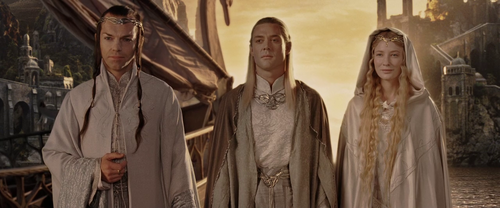
 have to defend their homes from an encroaching menace: the evil (dark) races.
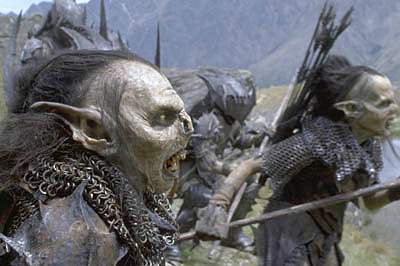
By this world-view the enemy is utterly defeated when the leader is defeated. The battle between good and evil is fought between an army of each, with battle lines drawn, to the death. This is perhaps a view to be expected from a man who had experienced trench warfare; who had returned from the hell of chemical weapons to the bucolic surrounds of English pastoralism; who had seen all the power of industry turned to the destructive effort of war, and thus rejected industry as being itself destructive.

How could we, the modern readers, share this view? We are now more than a decade into the War on Terror. We have witnessed the fall of Sadaam, the killing of Bin Laden, Gaddafi murdered in a ditch by revolutionaries. We have seen Egypt fall and rise and fall again. Seen tyrants overthrown and replaced by corruption or chaos, have seen the empires of democracy spying on their own citizens. I cannot see a world in which good gathers its (white) people to its cause to defeat the encroaching evil (black) people. But that doesn’t mean that good and evil no longer battle.

Modern Fantasy does not show a world where evil is the ‘only game in town’. It shows a world in which the battle between good and evil takes place not between people, but within. Each character has good and evil within them, and each must allow that battle to be fought. In some evil wins, but not in all. Interestingly, the protagonists are seen by others as evil, perhaps even acknowledge that evil in themselves, but wish they could be better. The characters we hope to see succeed, Logan, Glokta, Shy, and yes even Jorg and Monza, (and why not throw Jaime Lannister in for good measure?) believe themselves to bad, but hope that they can be better. (For Jorg that hope comes late, and slow, and even as it comes he resists it – because he’s not one to be pushed – but it is there).

Sometimes these characters don’t achieve ‘goodness’; sometimes they are trapped by circumstance or history or any number of other forces, just as some good characters are corrupted, unable to maintain their goodness in the face of circumstance.
I want Glokta to succeed because I want for him the same thing he wants for himself, it’s just that he has given up on achieving it, while I hold hope. I want Logen to find peace because I want to believe that men can redeem themselves of past misdeeds, especially when those misdeeds weren’t entirely voluntary. I want Jorg to be a better person, because he’s not a very good person.
This isn’t to say that the battle between good and evil doesn’t take place. Many such battles are taking place, fought by independent splinter cells and sleeper agents, the battle-lines ill-defined and constantly shifting.

Which brings us to…

2. Fantasy is not just for boys.

It’s frustrating that this even needs to be said, but for Walter the success of evil he believes defines Modern Fantasy “says more about the psyche of the young male readers and writers who dominate grimdark fantasy than anything else.”

This is just so wrong-headed that I can’t even bring myself to invest much energy in the debate.
On Goodreads, the 5 star reviews for ‘The Blade Itself‘ include reviews from Maria, Kat, Inara, Annie, Faye, Sara and many other female readers. Likewise for ‘Prince of Thorns‘ we find Amanda, Rose, Natalie, Georgia, in the top dozen or so.
I could go on, but really – why bother.
As to only young men writing Modern Fantasy…
Ursula LeGuin, Robin Hobb, Trudi Canavan, Marion Ziommer Bradley, Janny Wurts, Anne McCaffery… of course JK Rowling. These authors aren’t mentioned as Grimdark, but I wonder if that’s because of how subjectively applied is the label. I do know that from my own experience in Australia I have met many talented women writing Fantasy and Spec-Fic. I struggle to believe that they are the exception.


Grimdark

So I’ve basically played the role of a vaguely interested observer in all this, but something Joe Abercrombie tweeted today – a piece by Daniel Abraham in Clarkesworld – has finally motivated to reach into my proverbial pockets and draw out two-cents, which I now humbly submit to the debate.

As Abraham notes the moniker “Grimdark”  is taken from Warhammer 40,000 (affectionately known as 40k). I played the game as a young fella. I had my armies (Eldar predominantly, but I did put a bit of an Orc Horde together and was compiling some Imperial Guard when I gave it all away. The miniatures  including some incredibly carefully and poorly painted Banshees and Scorpions, were sadly lost in a house-fire) and would spend long afternoons plotting the fractional movements required for victory or poring over a codex seeking some tactical advantage. I didn’t get too much into the surrounding mythology of the 40k universe, but it grew exponentially whilst I played and subsequently. I am aware now that entire novel series are devoted to the expanded universe, in much the same way you’ll find with Star Wars and Dragonlance and such.

I am familiar with the line from which “Grimdark” apparently comes: In the grim darkness of the future there is only war.

Two of my favourite modern Fantasy authors (Abercrombie and Richard K Morgan) have been labelled as writing Grimdark, as well as Mark Lawrence,  an author highly recommended to me and near the top of my to-read list (after I finally finish Red Country, which I am powering through at amazing pace). Judging by Abercrombie’s thoughtful response, and Richard Morgan’s, neither of them are thrilled at the assignation (though Joe seems to have embraced it with his twitter handle), but more on that latter.

Mark Lawrence’s response basically summed up my own, but seeing as we’ve made it this far, let’s unpack it a bit.

Genre is a fraught concept. At its best it’s a useful framework for understanding tropes and narrative archetypes, at its worst it’s a cage, a ghetto, a straight-jacket. Mieville’s reference to Tolkein as the “Big Oedipal Daddy” of Fantasy is perhaps a starting point in identifying how the Fantasy genre came to be seen both from within, and from without. Fantasy was escapism for nerds. It was largely derivative to its progenitor (and “Author of the Century” no less) and it operated within variations of his British agrarian idyll being threatened by malevolent forces.

Arguably this continued until recently, arguably very recently, arguably it continues still. Many would point (as Abraham does) to Thomas Covenant, and fair enough. Others would point to George RR Martin, whose Game of Thrones was published in 1996 and featured many of the traits now assigned to Grimdark: the amorality, the incest, the rape (so much rape, so casually put to the page), the murders, the attempted (and successful) infanticides, regicide, ultimately (spoiler alert of sorts) the death of the apparent protagonist before the end of the first book.

But Grimdark seems a more modern label than either of these. Perhaps it is the HBO effect and GRRM’s ever-growing fanbase, but even that is older than Grimdark, being in place for two years at least. And so the finger is pointed at Abercrombie (whose First Law books were published in 06,07 and 08), Mark Lawrence (Broken Empire 2011, 2012…), and Richard K Morgan (A Land Fit For Heroes 08, 10…).

Morgan is particularly interesting, because it’s his Fantasy books that see him labelled as Grimdark, but his previous series (published between 2002 and 2005 and focussed on Takeshi Kovacs) wears a label of sci-fi/noir. As Morgan himself points out it is the elements of Noir that he brings to Fantasy which are most likely what is used to label his work Grimdark. The Kovacs novels have been credited with reviving Cyberpunk (the genre spawned, or at least identified, by William Gibson‘s Neuromancer) by grafting “the Gibsonian subgenre” back onto pulp fiction, and I think particularly in this Noir Pulp. It’s a link Abraham makes as well in his Clarkesworld piece, though by Abraham’s distinction I personally see Kovacs as more Hard-boiled than Noir. Kovacs does make moral decisions that go against his self-interest, the difference perhaps is that Morgan makes his protagonist pay the cost of those decisions. Kovacs gets no free pass for having done, or having tried to do, the “right thing”.

Likewise with Abercrombie’s flawed “heroes”.  Logen Ninefingers has a past he wants to escape, but can’t. In much the same way as Morgan’s protagonist Ringil Eskiath (who shares a name with a Tolkeinian sword), Ninefingers isn’t given the freedom to just put aside the consequences of his past acts. He wants to be a better person, but it’s not going to be easy to change, and will be harder still to convince others of the change. Shivers suffers even more-so. The change in the Northman is pronounced, from when we first meet him during the final stages of the First Law, through his Styrian experience and his final, decisive, blow in The Heroes. It is not a change for the better. And yet it is a change we, as readers, can understand, perhaps even sympathise with. Is it enough to mean well, even if your actions bring ill consequences? Can we redeem our wrongs by good acts? Would I not too struggle to maintain the finer parts of myself if I had suffered as he suffered? I think these are essential questions for readers of this sub-genre, whatever we decide it should be called. I think these are essential questions for readers of all literature. Especially that last one.

Is it not this question that we ask ourself as Casablanca ends? Would I send the woman I love away, on a plane with another man? Would I risk something of myself for others, even if there was little hope of personal gain and a genuine risk of personal suffering?
When Harry Lime, atop the ferris-wheel in The Third Man, asks how much money it would be worth for one of those specks to simply stop moving, are we not being asked how much we value human life, being challenged to explain that value, or at least to respond in some way to a character who values it little at all?

Certainly in gritty stories, in amoral characters – or just overly pragmatic ones – we are challenged. I enjoy as a reader that I am. I enjoy as a writer exploring those questions and developing ways in which I can use characters to provide different perspectives on these questions and others like them.

The problem then with Grimdark is that it is used so often pejoratively, and often by those who are seeking to define what they dislike about a certain type of story. Abraham sub-titles his piece “Literatures of Despair” – a phrase he explains, but which I don’t accept. Morgan’s response dialogue is telling. The complaints (of the straw man) become ones of taste and of subjectivity. Some blood, but not too much. Some danger posed to the protagonist, but don’t kill him. Some hint of the enemy being evil, but no rapes or torture. A little military-based murder is ok, but no gore please.

I think allowing anyone – even a readership – to define a genre in such a way, to set up boundaries and borders in which writers should (or must operate), is a stultifying influence. Even more so if those arbitrary borders are then policed by self-appointed guardians, wielding indignation and harking back to a supposed Glorious Age.

If Grimdark is Noir come to the Fantasy worlds then it is no new thing. Indeed it’s taken a generation or two to move from the mainstream into Fantasy. In 1991 Silence of the Lambs swept the Oscars:  Best Adapted Screenplay, Best Director, Best Actress, Best Actor, Best Picture. The cinema-going audience were ready for a story in which the secondary character, an advisor to the FBI (and thus in some way on the side of the ‘good guys’ even if reluctantly) was a cannibal serial-killer. Lector’s escape was celebrated, anticipated not as a defeat of the ‘good’ but as a victory for a character with whom the audience had become fascinated.

On television we watch Dexter, the serial-killer with a ‘Dark Passenger’ and a mission, and hope he doesn’t get caught. We admire Omar Little, a man we have witnessed murder and steal. We hope that Walter White can keep cooking and distributing crystal-meth, because doing so doesn’t make him a bad guy… not exactly… kind of… I don’t know. And that’s the point. These characters are fascinating and exciting and wonderful precisely because I can’t answer that question.

Is it any wonder the audience of modern Fantasy is ready for similar characters? Is it not a good thing that I started questioning why I should still be barracking for Monza to get her revenge, that I should question whether the world wouldn’t be better off if the ‘bad guy’ had’ve just killed her off in chapter one? I want characters who are flawed, who make mistakes, who do things I would never do, who suffer in ways I hope never to suffer. If it serves the story, put those guys through the wringer. Carve them up, piece-by-piece, and let’s examine what’s left at the core of them.

All of that’s fine. All of that means that I – now only two chapters into Red Country – honestly don’t know if I want Shy South to catch up to the bandits who took her brothers or not… and surely that uncertainty, that hesitancy, surely that’s a powerful narrative force.


On Cover Art and the Judging of Books Thereby…

At last year’s Genrecon one of the undoubted highlights was a snark presentation of covers given by Sarah Wendell of Smart Bitches, Trashy Books. Of course her particular focus was the Romance novels, an easy target perhaps for snarking, what with Fabio and man-titties (as opposed to man-boobs) and various other such tropes. It came to me though that Fantasy was as easily lampooned, the Hooded man, the enthroned King, the busty and poorly armoured warrior woman.

Covers are vitally important, despite the old adage that does not bear repeating. Perhaps in the ebook market this is less true, as opening a new ebook usually will take you to page one rather than to a cover, but with the flood of product a good cover is still an effective way to draw clicks to your Goodreads, or Amazon, or Kindle store presence.

I was surprised to hear from published authors how little control they had over the covers with which their novels appeared. I did here some anecdotes of cover artists communicating with the author, or perhaps even reading the book, but these were told as exceptions, remarkable precisely because they were not the rule. In some cases the author hated the cover which the publishers used.

Some years ago my sister recommended a book to me:

A-Game-Of-Thrones-George-RR-Martin-Book-Cover

This is (I think) the 1997 edition.

On the back cover, below the blurb, there’s an image of a white wolf running through the snow.

Here, I thought, is everything I hated about Fantasy.

The swordsman in black, the black warhorse, the snowy castle, the raven…

Could these images look more hackneyed and clichéd?

It looked terrible.

I read a chapter or so in case she asked me about it, then it was shelved.

Some years later I found this book in a book store:

AGoT_UK_Current

This is the 2003 edition under the Voyager imprint.

There’s a few extra endorsements, as over the intervening years and sequels Mr. Martin’s work had gathered a following and some rave reviews, but they’re mostly the same.

The blurb is much better on this than on the original, and I’m certain that that played a role in my selecting it too.

I bought it and began reading it without ever making the connection to the book my sister had given me.

It was only when I was several chapters into the book, and hooked, that I started to make connections with the earlier book I had shelved (or in fact, by that time, boxed-up and stored under the stairs).

For five years I had ignored a great Fantasy novel because of its cover.

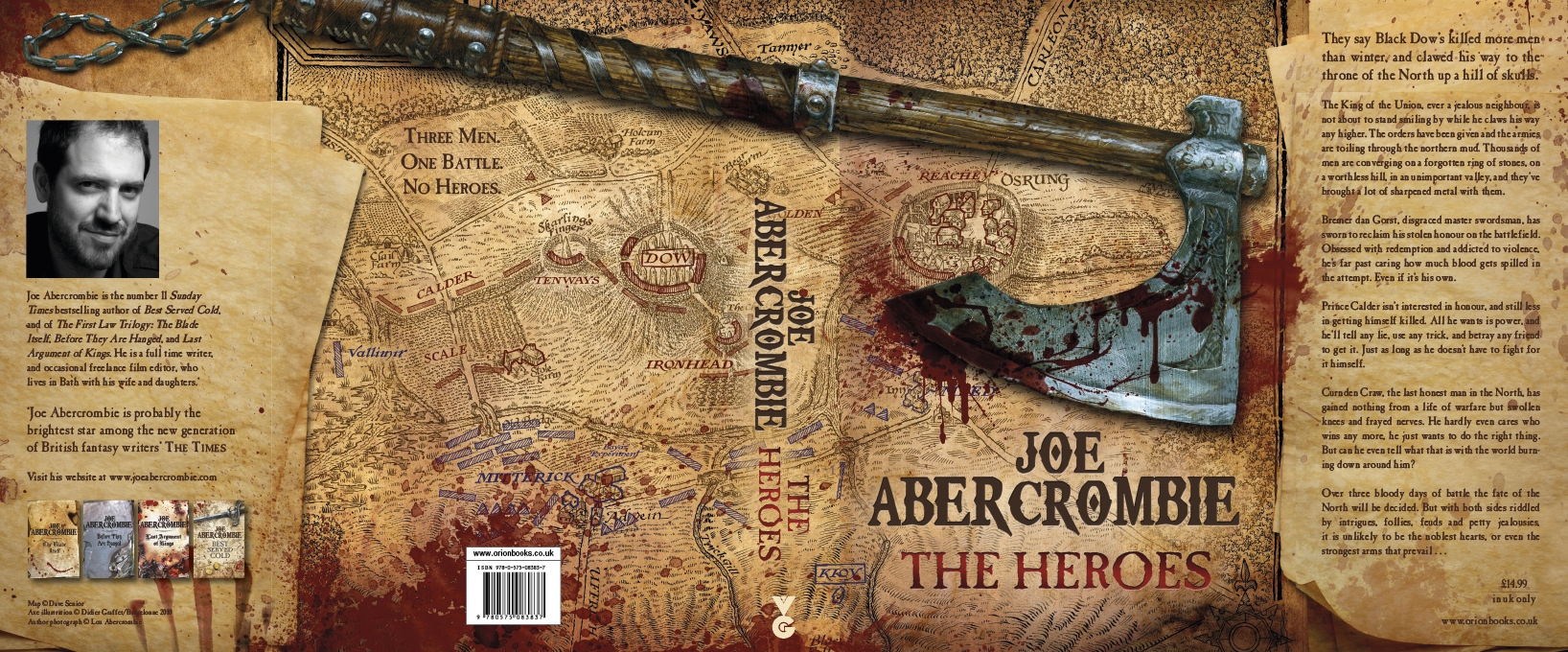
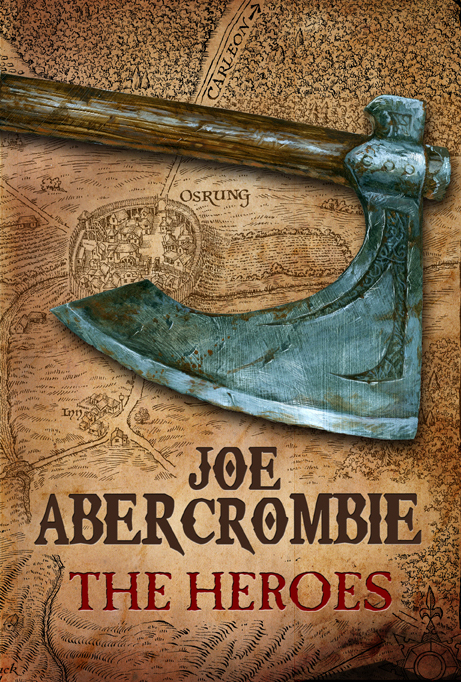
Another example of a cover leading me to great fiction is Joe Abercrombie’s The Heroes

The-Heroes-HB2front

I had a voucher to a bookstore sent to me as a Christmas gift, and I went in to buy China Mieville’s collection of short stories “Looking for Jake”, but I had some money left over and no real plan so I browsed the shelves.

Abercrombie’s views on maps have been well explained, and he included none in his First Law trilogy (which also have great covers), but this cover (as with the covers for “Best Served Cold” and “Red Country”) manages to convey I think a very real sense of Abercrombie’s world and the style of Fantasy he writes.

I like them far more than the hyper-real close-ups of the US covers.)

I bought it, loved it, and went back through the First Law and “Best Served Cold” in a matter of weeks.

Here’s the jacket of Heroes in all its glory (click the image to enlarge):

The-Heroes-HB_jacket

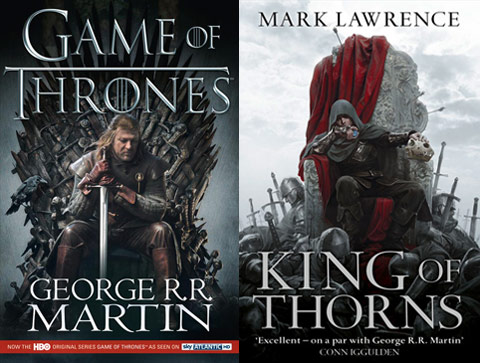
Recently the author Mark Lawrence responded to some suggestions comparing his cover for King of Thorns to GRRM’s Game of Thrones (specifically the Sean Bean cover that was released to tie-in with the success of the television series)

2013-01-03-book-cover-twins

Lawrence’s response was to refer to similar covers back through the history of genre and still being released:

Conan_the_LiberatorPromise_of_Blood
His point of course is well made. The mere similarity of having your protagonist (if Ned is the protagonist) sitting a throne is as much a part of Fantasy as the heroine swooning in the strong arms of her hunk is a part of Romance.

It’s always tempting of course to judge these covers. Whether they are examples of the best the genre has to offer, or some of the worst covers in the history of literature, there’s no denying their effect. It was suggested that the success of Fifty Shades of Grey in breaking beyond the Erotic Fiction market and into the mainstream was (in part) because it didn’t look like a typical Erotica cover.

It’s also worth acknowledging that the covers do not always reflect or represent the novel in the way the author would wish though, so in the interest of dispelling that hoary old cliche and admitting that of course we all do judge books in this way I invite you in the comments to nominate others.

What covers have made you pick up a book you went on to love?

What covers have drawn you to a book that you hated?

What covers have chased you screaming away swearing never to inflict such rubbish upon yourself… at least until they repackage it?


Gender, History and Fantasy

This one’s a multi-headed beast, so bear with me.

I guess this has been percolating away since I read The Mary Sue article  exposing James Gunn’s misogyny and homphobia. I’ve gotta say it took a lot of the shine off the Guardians of the Galaxy announcement.

Then I became aware of The Hawkeye Initiative on Tumblr, which does a disturbingly good job of depicting the inherent problems with the portrayal of female superheroes (and villains) as objects posing sexily (in impractical outfits).

I’ve been trying to sort out my thoughts on the matter and apply them to the world of Fantasy Fiction… but then Tansy Raynor Roberts up and does a better job than I could have done in her blogpost picked up by Tor.com.

At the same time(ish) Cracked.com publishes Luke McKinney’s article about the ridiculousness of calling out fangirls.

So I’m left with little to say, having to follow in the footsteps of those who have said it so well already. But when has that ever stopped me having my say?

In my own work I thought I had drafted a strong female character. She was a POV character (in a novel with several POV characters) and she was smart and independent and strong. The reader would have known this because I attached these adjectives to her repeatedly. I did this while she was pushed through a narrative in which she showed almost no agency, made no meaningful decisions for herself, was considered (by a patriarchal culture) to be superfluous, and appeared in scenes where women discussed what men did. But she was sassy. And I did several times describe her as strong, independent and smart.

The reviews from my test-readers (and one in particular) forced me to sit back and look, really look, at what I had written for her. I didn’t like what I saw. So changes were made and I believe there has been much improvement. I have also given another character gender re-assignment, and this has been one of my personal favourite improvements in the rewriting.

Ellen Ripley was, in an early draft, a male. (S)He was to be the ship’s security officer (an obviously male role on the ship) and would probably have been cast by an athletic, muscled square jawed type, who would have killed the Alien and survived (with or without the grey panties – damn you Hawkeye! Must you ruin everything?) to fight another day. And the film wouldn’t have been terrible, but I doubt it would have been as good. It certainly wouldn’t have featured in articles in The Guardian celebrating the 30th anniversary of the ‘first action heroine’.
Why does Ripley endure so long after the two Alien films were made? (There were only two weren’t there – I’m pretty sure that’s right) I believe it’s because she wasn’t written as a gender stereotype. She’s a woman, but she’s not defined by that, and nor is she the pendulum reaction of Velasquez in Aliens (who is one of my favourite characters, but in many ways just a different stereotype).

The film Salt is forgettable (I’m not even sure I’ve seen the whole thing, I’ve seen bits), but it is interesting for the fact that the central character was written as a man. Tom Cruise was meant for the role, but withdrew because it was too close to his MI character of Ethan Hunt. At the same time Angelina Jolie was determined that she didn’t want to be a Bond girl – she wanted to be Bond. So a chance came up for her to be the action hero. Contracts were signed, but the deadlines were looming and there wasn’t time for a full re-write. They started shooting with the script for a male Salt and a few shifted pronouns (they did manage to take Salt’s children away from him/her – because while it’s ok for a father to risk his life as a CIA Agent fighting Russians a mother would never do such a thing – so it’s not perfect). The outcome is a film in which the character is played by a female, but not saddled with the gender stereotypes that are written for Strong Female Protagonists. (and some confusing scenes where a rake thin Angelina overpowers goons with brute force).

I met Tansy RR at Genrecon recently (in the sense that I nervously said hello once or twice and joined in a conversation with about ten people – of which she was one). Her take on history is fantastic – and backed up by an impressive academic resume. If history is sexist, so be it. That doesn’t mean there wasn’t stories in which women played important roles. Hell, that doesn’t mean there weren’t women playing important roles in every story. It just means they were ignored. To take that fact and use it to justify continuing to ignore them is reflexive… and just straight-up dumb.

But even if we take patriarchal history as a basis, why should that apply to Fantasy? When Joe Abercrombie spoke at Genrecon he described his work as ‘Realistic Fantasy’ and admitted the concept sounded silly. I was relieved – I’ve been trying to define my own writing for some time now and I kept coming back to ‘Realistic Fantasy’ and getting caught in the oxymoron. The point is that as realistic as we want it to be its still our world to build. If Joe can be inspired by history and then have a character using magic spells to defeat his enemies then why is having a powerful woman going to break the story. How could a reader complain that women have too prominent a role on the basis of history, and yet happily accept the wizards?

And don’t think it doesn’t happen. Some readers make this complaint. It’s ignorant on two counts:

1. History is full of women doing cool stuff that could be the basis of Fantasy novels.

I’ll skip Cleopatra and move straight on to Lucretia, Cornelia, Vibia Sabina, Boadicea, Eleanor of Aquitaine, Empress Theodora, Catherine II of Russia, Queen Elizabeth the First! – and that’s just Western Europe. A quick googling will open up possible tales inspired by Hatshpsut (a female Pharaoh) or Empress Wu Zetian. Hell, tell Penelope’s story. Sure she’s just waiting at home for Odysseus, entertaining courtiers, but surely there’s an interesting tale to be told there. Tell the story of Queen Gorgo – just not one where she gets boned by Jimmy McNulty.

2. It’s Fantasy.

History might have cast women in certain roles, but the history of my fictional world has not – or more accurately it has cast them in different roles. And even if it’s a misogynist fictional world with a patriarchal hegemony, good fiction will come from the conflict of putting a powerful woman in there. How will she cope? How will society cope? What cracks will emerge? What conflicts? Will she be defeated? Forced into submission? Will the power structures shift, compromise? Will she inspire a revolution? This is what drives narrative. This is what makes it a fictional story worth the reading.

I’ll leave the last word to Scott Lynch, who here responds to complaints about one of the female characters in his second ‘Gentleman Bastard’ novel Red Seas under Red Skies.

Comment, criticise, condemn, condone, as you will.

Or debate me face-to-digital-face / pat my back on twitter @jmichaelmelican


Genrecon Australia 2012

Last weekend I went to the inaugural Australian Genrecon and I have to say WOW! What an excellent decision that was. Yay me!

Of course the real congratulations should go to the likes of Peter M Ball, Meg Vann, and the ninja team from Queensland Writers’ Centre. What a magnificent event they organised and managed!

This was my first ever convention, and I have to admit I had no real idea what to expect (or what I was doing). I read a few tips. Chuck Wendig’s were pretty helpful. A lot of common sense of course but a good guide nonetheless. (He was also quoted in a panel by P M Newton: ‘Plot is Soylent Green’)

The other massive help was Twitter. I was flying basically solo… I knew a couple of people from online interactions, but only one person I’d met face-to-face. So when I walked in to the opening function on Friday night it was a massive relief to start recognising some twitter handles on name tags.

One face I did recognise was International guest of honour Joe Abercrombie. He was surrounded, and congenial and charming and gracious and relaxed and just a wonderful international guest. Full credit to him.

I managed to spark up a chat with Ginger Clark, about whom I knew enough from twitter to give me some icebreakers. We discussed zoos and Australian fauna and Sandy and suddenly the crushing weight of Curtis Brown NY was lifted a little. She’s really a nice person and I had a lot less fear for my Sunday pitch.

The adults only panel was excellent. Good natured and great fun. I worried that I had made a fool of myself in a discussion of the C-bomb, but everyone was great. I’d never considered the difficulty romance writers had choosing between descriptions which were either twee or coarse.

Afterwards I met some great Romance writers who were kind enough to explain to me some of the subtleties of their craft and how careers are forged from one’s writing. Thanks to Denise Rossetti, Nikki Logan, Anna Campbell and Alexis (sorry Alexis – I forgot your surname).

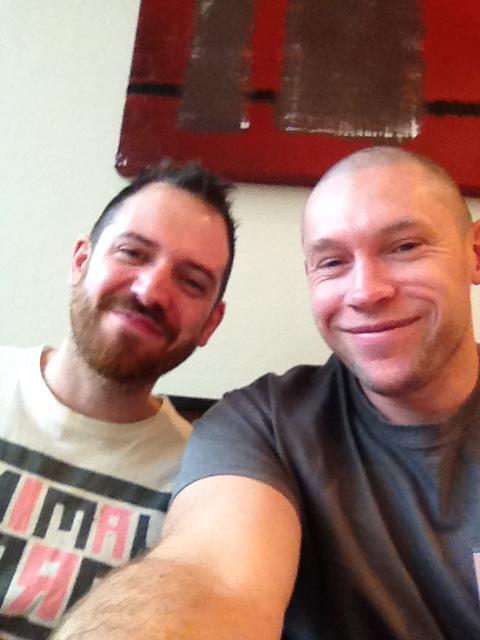
I’m on the right, with idiot grin!

Saturday morning was a great highlight. I was running a little late, stopped in for a quick toast and a take-away coffee with the intent of sneaking into a 9am seminar moments late, but Joe was alone at a table, enjoying a pretty good approximation of a full English brekky… what’s a fanboy to do?

Joe was great. We chatted like old pals for nearly an hour. Talked black pudding, Lancaster accents, kids, nappies, travel, Australiana, First Law, Red Country, westerns, my fledgling attempts at a career, Batman as vigilante and Superman as fascist. I got a photo in which I’m grinning like an idiot child on Christmas day.

That an author of his stature should be so welcoming and open, and for him to show such interest in what I was writing, was magnificent and I am so grateful!

The panels were universally excellent. Special mention goes to: Kim Wilkins and her impressive (to me especially) use of Old English; Crime author P M Newton for being so erudite and articulate in the face of Joe Abercrombie’s wise-cracking; Peter Ball and Alex Adsett for their insights into writing as a career; Ginger Clark for her excellent presentation on what an agent does (and how);  the Saturday night Snark from ‘Smart Bitch’ Sarah (Platypus of Doom, Gay Tarot Reading Vampire Were-Roos, Mr Darcy’s horrible secret…); the conversation with Joe Abercrombie (of course).

Thanks also to Peta Freestone and Amie Kaufman for helping me hone my pitch, and to Lindy Cameron of Clan Destine press for her encouraging feedback.

Thanks to everyone who made the weekend so wonderful (especially my wife, who looked after our two boys solo all weekend! How did I get so lucky to have such support?).

It ended with a successful pitch (with a caveat for length) to Ginger Clark and an invitation to submit pages. Could not have hoped for anything more!