Category Archives: Musings

On arrogance, self-doubt, and sucking at stuff.

Tonight I did some writing and it was hard, and sucky. Just bad, sucky writing that sucked.
It took me an hour too and there wasn’t very much of it. It was so bad it made me wonder why I was bothering to write anything at all.
This is the response that I came up with:

Perhaps any act of writing — perhaps any act of art — must start from the basis of emulation, at least insofar as to say ‘here is a thing which I appreciate, and I believe that I can create something of its ilk. I can create something like this, even something better than this.’
For me the stimulus was (and I mean no disrespect to the author here) Raymond E Feist‘s Magician. On my second or third reading of that book, still a teenager, I started to see that I could parse its structure. I realised that it had form and function. I peeked behind the curtain to see not the players upon the stage presented to me but the craft that had gone into building that stage and showing those players.
My first efforts them were deeply emulative. As Neil Gaiman said, ‘most of us find our own voices only after we’ve sounded like a lot of other people.‘  (Have you heard that keynote speech? No?! stop reading this and go watch that now, then come back. I’ll wait…)
I lay no claim to having created anything the equal of, certainly not the better of, Magician. At some point though, as a cocky teenager biting off more than he could chew, I believed that I could. It may be that I yet can. My understanding of the process is deeper now, more nuanced, and still requires a degree of self-belief that spills over into arrogance in order for me to maintain the effort required.
There is a very strange dichotomy at play between the swaggering arrogance (and examined objectively it can be nothing else) inherent to the belief that I can craft narrative from thin air, that I can create prose which communicates emotion to a reader I have never met and do not know, and the depths of despair that haunts and preys and lunges upon the writer, upon any artist, at unexpected times.

Self-doubt. What a son-of-a-bitch is self-doubt. Here you are, going merrily along, assured of your own brilliance,  reading over the words you just put down and wondering how you managed to write so wonderfully, and then one day… one day you just get an hour to yourself with something to write and crack your knuckles and get started… and you realise it sucks. All of it. What you’re writing now sucks. What you wrote yesterday sucks. Everything you’ve written so far sucks. In fact the entire concept sucks. Why are you writing this thing at all? This sucks. You suck.
This is what happened to me tonight, and in the past this would have sent me off into other things and I would have shelved the writing and come back weeks or months hence and started anew.
This is what self-doubt does. It takes something you’re doing, smears it in sucks, shows it to you, and aims to make you so revolted that you flee. It has conquered me in the past.

Not this time.

This time I recognise this phase for what it is. I have discovered — with thanks to social media and generous, honest writers who’ve shared their travails as well as their triumphs — that this is a common part of the process for even those successful, professional writers, and undoubtedly artists in all media and form. It is important to make mistakes (you watched the Gaiman video above, yeah? Good).  You must give yourself permission to suck. You must, as Kameron Hurley implores, persist.
So I shall.
I took some time away from the Work In Progress to get these thoughts down for two reasons. The selfish reason being that by writing them here I am at least writing something, and in the process of writing them I have reinforced their value for myself. The second reason is more altruistic. Surely there are others out there who have hit this same point and not had the strength or the support or the advice to go on. If you’re there now and you’re reading this, chin-up, fist-bump, I’ve been there too, and others have, even the best have.

The difference, I believe between the best and the rest, between the successful and the unsuccessful, is that the best, the successful, kept writing even when it sucked, and they fixed it later. So that’s what I’m going to do. 


Tolerance, boycotts, and the separation between art and artist

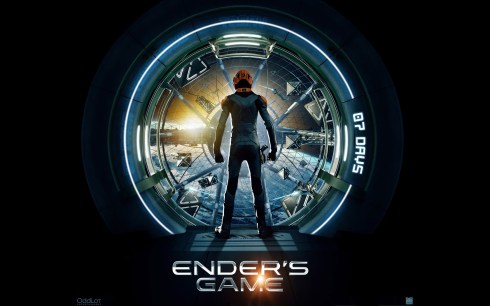
Originally this post had been meant to coincide with the release of the Hollywood adaptation of Orson Scott Card’s “Ender’s Game”.  I have subsequently added to it, and it is now quite long.  I would welcome any responses to the questions I pose.
5212-6484647364-ender

In the lead up to Enders Game there had been controversy, and calls for a boycott, on the basis of Card’s strongly held and strongly expressed views about homosexuality, homosexuals, and the law (and apparently just his “goddamn lunacy”).


Now I haven’t seen the film, and it has been about two decades since I’ve read the book, so I don’t want to broach here the topic of whether the material reflects Card’s views (if it does my adolescent-self didn’t pick up on that consciously, but then my adolescent-self had no real concept of LBQGTI realities, heteronormativity, or cisgender).  Nor do I want to discuss the quality, or otherwise, of the film or its source. What did interest me in the discussion is the way that our knowledge of the artist’s personal views and politics influenced the way we received the text.

I got distracted, as happens, and missed the launch of the film (which premiered and screened and disappeared without too many waves of praise or condemnation) and shelved the issue, thinking I may have missed its relevance. Then Shia LaBeouf was in the news, and now Woody Allen, and while the issues that caused the controversy which now surrounds each of these men and their art are vastly different in nature, the core issue of interest spans all three:

Can we / should we judge art by what we know of the artist?

(I will discuss each in turn and try to speak sensitively, particularly regards Dylan Farrow, but I do here want to give a trigger warning on discussions of child sexual abuse, just in case).

Now in posing that question, I accept as a baseline assumption that we do. I know I do. To take one example: I won’t listen to Chris Brown songs because, a) domestic abuse, and b) they are terrible. Yet despite Roman Polanski’s history I can still appreciate his version of Macbeth.
I assume others experience these same reactions.

Orson_Scott_Card_at_BYU_Symposium_20080216_closeup

When Orson Scott Card’s novel Ender’s Game was soon to be released as a film many groups (such as Geeks Out) called for boycotts, or stated that they wouldn’t go to see the film, as a form of protest against Card’s homophobia.  Tyler Coates responds directly to this call, accepting that Card was a homophobe (or at least that Card had published an article in 1990 which contained homophobic material), yet disagreeing with the boycott. In doing so he explicitly separates the art from the artist. He allows that we can accept that Card is homophobic, without the entailment that his book, or the film based upon it, are themselves homophobic.
Card also responded to the boycott. His call for those who accused him of intolerance to now show him tolerance was a classical repositioning argument, calling for tolerance of intolerance, hoping to tangle his opponents in a syllogistic web. Chuck Wendig dismantles it in his own NSFW-because -sweary-words way on Terribleminds, and explains why he is boycotting. He also makes the point the the division between the art and the artist is “thinner than we like to think.”

For myself, I didn’t boycott the film per se. I didn’t see it though, so perhaps the controversy did enough to turn me off it. I felt a boycott would punish so many other people than Card, the actors, the director, the studio, the crew, etc. I expected that most of these people would not have shared Card’s views, some or many of them were likely themselves victims of Card’s prejudices, and yet their incomes or careers may have depended to some extent on the film’s success. But on the issue at the core of what I wanted consider – on the separation of the artist from the art – I ended up persuaded that a homophobe could produce a book which not only was not itself actively critical of gays, but that was ironically a tale which might empower the LBQTGI reader. In much the same way that Charlton Heston could portray a character in Ben Hur who was intended to be gay without realising that he was, or the way Charlton Heston could portray a human as the victim of an ape hunting party while being a leader in the NRA.

Alyssa Rosenberg’s piece from Think Progress gave four options for how to approach the situation of Ender’s Game. It is the fourth that I chose:
4. Commit to a discussion: All of these actions are useful to do in private. But whatever you decide in relation to Ender’s Game, talk about it. Talk to the people you would normally go to genre movies with, but whose invitations you’re turning down this time. Talk about it when you decide to go, and explain why you’re making the decision—but also why you’re taking offsetting action. Speak about this from a place of conflict if that’s what you’re feeling, as a genre fan, if that’s what you are. Ethical consumption is a difficult thing to do. And exposing that difficulty and those contradictions, and that they’re part of your process as a consumer, is perhaps the most important thing any of us can be doing, whether we swipe our credit cards or not.

And so in that spirit:
Shia

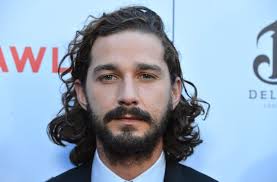
Shia LaBeouf

I honestly have lost track of what the hell is going on here. LaBeouf plagiarises Daniel Clowes, and later apologises, but then it turns out his plagiarism apology was plagiarisedat some point there was an apology written in the skythen they go back that he had plagiarised an email about his father and what it meant to be a man, then he retires from public life, then people are so confused they think maybe the whole thing is performance art, and then Shia agrees that -yeah, it’s performance art, and he plagiarises his explanation of plagiarism as performance art, and by now he’s a meme (because everything will eventually be a meme).
Among all of this ranting and confusion LaBeouf has offered up the explanation that there is no artist, there is only the art, that all art is plagiarism, that authorship is censorship, and other meta-post-modernist theories that seem to have given him the justification for taking another person’s work and without credit passing it off as his own so that he might profit from it.
In that regard at least there needs to be a connection between the artist and the art, if not one of ownership then at least one of authorship. Once that connection exists then, as a consumer, I must be aware that my support of a work of art is support for its author, for its creator. Financial support certainly, but support beyond that also for the whole edifice of artistic expression, for the whole system that allows for people to survive, to thrive, as a reward purely for their capacity to create.

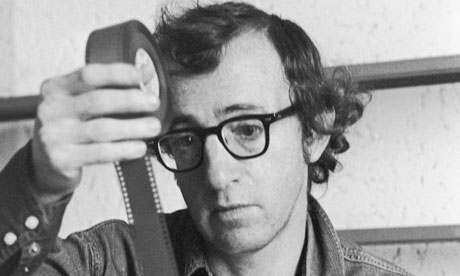
Woody Allen

And so to Woody Allen, who by any measure has thrived as a result of his Hollywood successes. He is in the midst of an award season that will honour him for a lifetime of creating art. 
The allegations he currently faces are not new, indeed they have passed the statute of limitations apparently by over a decade. When they were first made an investigation was undertaken which did not find enough evidence to continue. 
I know little of this case in its specifics, and that through the lens of media. Certainly I am not qualified or able to assign guilt or to suggest that I know the truth of the allegations.
I did read Dylan Farrow’s open letter though (here, with a reminder that it frankly discusses the abuse she alleges), and it was a difficult thing to read. I have not personally been the victim of sexual abuse, but I know victims, I have spoken with victims about their experiences and the feelings that arose from those experiences. I made enough of a connection between Farrow’s description in her open letter and the cases I know personally to form a storng personal opinion.  Enough to make me query the ethics of supporting Allen’s art.
Cate Blanchett and Alec Baldwin, both among those mentioned by name in the letter, have each spoken about this being a matter for the family, and not for outsiders. Allen himself has repeatedly in the past, and again in recent days, denied the accusations. Yet with Mia Farrow, and Dylan, and further tweets from Ronan Farrow (Dylan’s brother, Mia’s son – and possibly Woody’s) being made so publicly how can we as consumers be expected to remain clear of the situation? Either we discontinue support for Allen, on the basis of these allegations, or we continue to see his films – knowing that his profile in Hollywood brings Dylan further anguish –  in an act of either explicit or tacit support for him.
The ethics of this decision, and the ethics of Hollywood‘s decision(s) to either continue their awarding of Allen’s work or to distance themselves from the art created by a tainted artist,  are difficult. Ultimately they must decide if awarding his work, and him as the creator of that work, in any way endorses his character. I suspect it need not, but the realpolitik of the situation may not allow that cold rationalism to stand.

For myself, as a writer, I have no such dark skeletons in my closet as homophobia, plagiarism or sexual abuse allegations. I do though have strongly held political and social views. Many of these will have opponents who equally strongly hold their diametrically opposed views. This makes starting out as an writer feel sometimes fraught. I wonder will the art I create be assessed and enjoyed independently of me. I suspect that’s an easier thing to be assured in when you have no public profile, but we all now have the public profile of social media. I re-worked my name so that my writing would not be immediately obvious to a casual search of my name. I am strident in my views on my personal Facebook, but muted on Twitter where I try to maintain a more neutral and professional presence. I wonder if this self-censorship is even necessary. I wonder whether revealing my political beliefs will alienate potential readers.
Why this fear? Because I have experienced the phenomenon as a reader:

Some months ago I saw the twitter stream of an author I was considering reading (or at least adding to my long to-be-read list). I don’t remember the author’s name now. A few tweets was all it took to remove that author from my list of future reading, because I found that she supported many social-political view-points with which I disagreed.

Was I unfair in that? Should I have given the books a chance to speak for themselves without being coloured by my view of the author’s politics? Would I have read the books if I hadn’t seen that author’s personal views? Would I be disappointed if a potential reader was lost to my speaking out on an issue that I believed in.
In all three cases I am almost certain that the answer is yes, yet not for a moment have I regretted the decision I made.
The flip-side is likewise true; I have actively sought out the books of authors whom I have come to realise might share my interests and socio-political beliefs. For writers still seeking to make their way, to find their niche, to find their audience, I believe that there is an important lesson in that.

2013

Well, this year is about wrapped up, and as is the want of the season I figured I’d take a look back and see if I could somehow parse some meaning from all of those events that occurred:

Best Books:

I read some excellent books this year.
Noteworthy was Joe Abercrombie’s ‘Red Country‘, which was much anticipated and lived up to lofty expectations. I really liked the returning characters and the new ones even more so, and Joe’s continuing breadth of hybridised genres remained an invigorating force on my appreciation of modern Fantasy writing.
I also read several of Chuck Wendig’s books. You might have noticed I referenced him repeatedly this year on the blog, and with good cause. I ‘discovered’ his writing through the terribleminds website and his advice to writers, and I’m glad that this led me to his fiction. The Miriam Black books were great. His Corn-Punk YA and Atlanta Burns stories were good excursions into a genre I don’t read enough of, and Blue Blazes was great. I still have a special place for the first of his books that I read though, the tales of Coburn, a vampire who wakes up in the zombie apocalypse and must become a shepherd to his ‘sheeple’

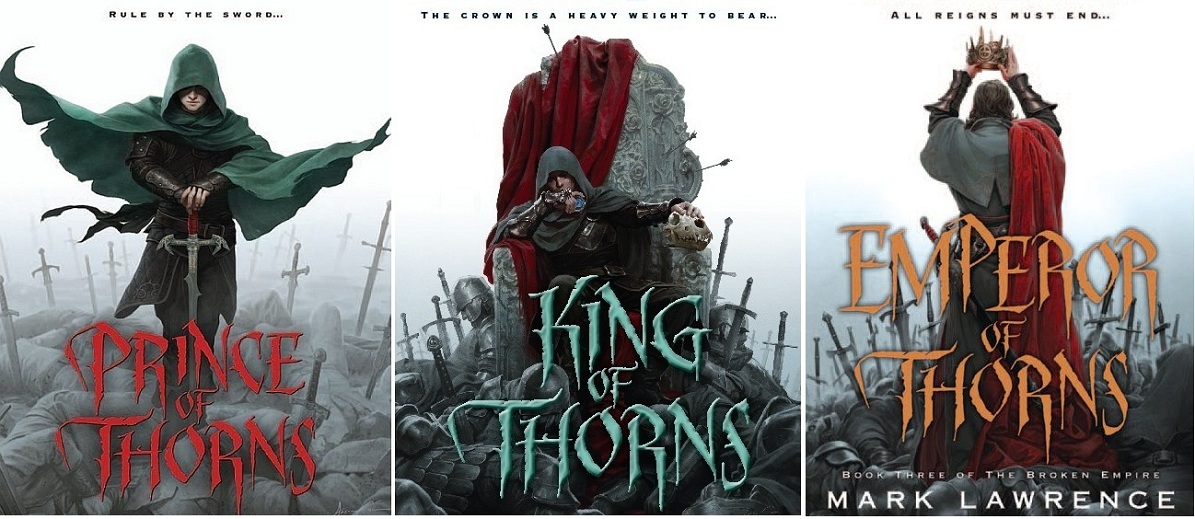
Against this stiff competition though rose Mark Lawrence’s trilogy (Prince, King, Emperor of Thorns). It has caused some controversy in some circles but I didn’t find the protagonist as shocking or evil as some of the criticism would suggest. He wasn’t a good guy, but I think he was trying to be without really knowing how. In that sense he wasn’t so much different from other protagonists I’ve read. He was younger in book 1, but as the book progressed that feature became less pronounced, and given the images of teenage ‘soldiers’ coming out of Syria I had little problem accepting it. The world was interesting, but several queries regarding technology level and such went unanswered. I would happily recommend them and look forward to reading Lawrence’s future works.

Best Graphic Novel:

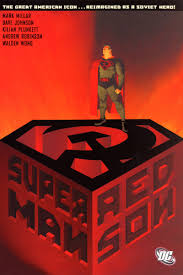
It’s a small field, as I don’t read too many, but I did finally get around to reading “Red Son”. I’m not really a fan of DC and certainly not of Superman who I think tends to fascistic fantasies of control, or to some infantile desire to be protected and guided by a greater being. I was interested in how the Superman mythos would play out against the Soviet political ideals, and while ‘Red Son’ touched on this paradox it went largely unexplored. In the end I felt that the Red Son Superman was still an American, transplanted into Russia, rather than a full exploration of what a Soviet Superman would truly mean. It was an interesting and thought-provoking read though.

Best Film:

Surprisingly few real contenders here. I saw many of the big ‘tent-pole’ movies and usually came away with mild disappoint. ‘Elysium’ didn’t live up to its aesthetic and tried to sledgehammer me with a political message. ‘Into Darkness’ was silly, burdened by fan-service and more spectacle than substance. ‘Iron Man 3’ had some good sequences but seemed to lose the sense of character. ‘Man of Steel’ did a wonderful job of setting up and re-imagining a familiar origin story, but the Krypton scenes were unnecessary, the whole final act was terrible and Snyder’s misogyny kept rearing up ugly. ‘World War Z’, again, sacrificed story to spectacle. ‘Desolation of Smaug’ looked amazing but was weighed down under its own attempts to be an epic far beyond the proportions of its source material. ‘Pacific Rim’ had awesome robots and kaiju… and that is all. ‘Django Unchained’ was disappointing – particularly in the manner by which it relegated its eponymous character to secondary and tertiary roles when Waltz and DiCaprio were on-screen.

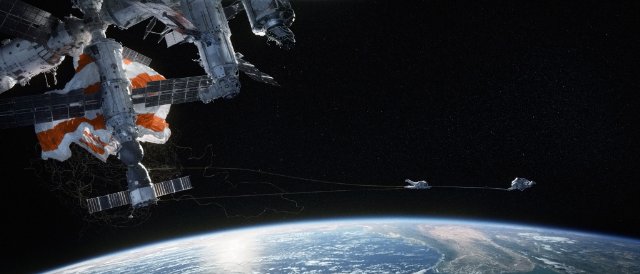
I think therefore that ‘Gravity’ gets the nod. Sure there were problems, as Neil DeGrasse Tyson pointed out, but it was a great experience. I saw it in IMAX 3D and it was beautifully immersive. I love Cuarón’s long tracking shots and the film’s opening was a wonderful example of how the technique can be well used.

(Special mention to ‘Wreck-it Ralph’ for being an absolutely awesome movie to watch with the kids).

Best Event:

Two great events for me this year as a writer.

Firstly, Genrecon 2013 gave me the opportunity again to meet so many other writers in such a diverse range of specialities, and at different stages in the auctorial development. The panels and workshops were excellent, the community supportive and inclusive, the international guests warm and engaging, the banquet after-party sufficiently well lubricated.

Secondly, I saw George RR Martin and Michelle Fairley in conversation, hosted by the Wheeler’s Centre in a side-show to their Supernova commitments. Michelle was wonderfully entertaining and forthright. GRRM went over some adages with which I was already familiar – it must be tremendously difficult to answer the same questions in new ways – but also added some interesting insights into his process and the story thus far (such as his being uncertain that Bronn would even survive the Eyrie, only to watch as the character became important as a sounding-board for Tyrion, and then important in his own right).

Writing:

I have taken some strides here too, but not as many as I had hoped. I’m much more organised with my submissions tracking spreadsheet and a good list of potential markets to explore (thanks in particular to Peter Ball and Alan Baxter); I pitched my novel MS again and felt a lot more confident and assured in doing so; I have five finished short-stories this year, for a total of about 30,000 words.

I am not unhappy with that, given all of the external pressures on my time, but I want to increase that figure. Alan Baxter estimated himself as having completed over 250,000 words this year and Chuck Wendig has something like 600,000. Chuck’s a full-time pen-monkey, but he has a toddler and I am sure many of the same concerns and excuses that I do, so I’m not going to point at any of those as a way out, I’m just going to look at my 30,000 or so, nod, and acknowledge that I could do more.

2014:

Goals then?

  • To write over 50,000 words in 2014. For those not good on the maths, that’s about 1,000 a week. 200 words a day x 5 days a week. That looks do-able.
  • To have completed 6 short stories. That’s one every 2 months. I’ll need to do this and more to hit the 50,000, so hopefully this is a goal I can meet and exceed.
  • Reading 10 novels. That’s about one very 5 weeks, and I suspect this will be the tough one., because I want to hit this goal without including the reading I have to do for work, but perhaps the work reading will have to contribute.
  • Reading 100 short stories. That’s 2 a week, and I think this is an achievable one. I’ve subscribed to Daily Science Fiction, so even if I just read all of them I will be fine, but I’ll get subscriptions to a few other mags as well so that there’ll be the variety. I’m also reading Raymond Chandler’s short stories for work. I may or may not include these toward my goal.
  • Blogging. 1 post a month, at least, and I ambitiously hope to get one up every fortnight.

So there you have it: 2013 tucked into the past and a clear guiding line through 2014. Thanks for following and being a part of it. I appreciate that there is some sense of an audience out there and it helps me to stay motivated knowing that there are readers waiting.

Happy New Year to you all. Hope it’s been a good ’13 and a great ’14 ahead.


Equality, Diversity and Appropriation

Recently (actually about a month ago) Joss Whedon spoke at an Equality Now function. In some circles this was lauded (Jezebel called it perfect), others were less certain (such as The Mary Sue), and many were downright critical. I don’t want to down-play the importance of the feminist discussion, and we should all recognise just how problematic is the depiction of women in genre fiction and genre fandom. (If you don’t, try scrolling through the images here, many of which are drawn from Whedon’s own work).

I am a Whedon fan, but not a full Whedonite. I loved Buffy and Angel. I loved Firefly. Dollhouse, not so much. Serenity was ok. Cabin in the Woods was clever but problematic in many ways, not the least of which was that in its knowing parody of sexist horror tropes it conformed to all of the sexist horror (as explained brilliantly by Kirstyn McDermott). But I digress. With no disrespect to the importance of the feminist discussion,  an article by Clem Bastow got me thinking about Orientalism, another aspect of equality that genre fiction needs to confront.

Rebecca Brown’s essay on Orientalism in Firefly/Serenity gives a great outline for what Whedon has done in drawing on Oriental aesthetics and culture, but what he has not done is drawn into stark focus by Mike Le. A future culture in which Western and Oriental language, fashion and philosophy is blended, but no one exists who is of Asian appearance? Le rightly asks if such a gendered world could have been made – a world of male and female cultural equality – without female characters. I suspect not. I am certain, not.

I was reminded of Richard Morgan’s future/noir novels in which Takeshi Kovacs is protagonist. The character is explicitly located as being culturally Japanese/Slavic (and fiercely pedantic of the pronunciation of his name: Koh-vach). For all sorts of reasons related to the technologies available in Takeshi’s world the physical appearance of the character is less relevant than you might assume, but this is the internet’s #1 image of him:

And here he is on a book cover:

That’s some obvious white-washing, and even if we give Kovacs a re-sleeving pass, there’s plenty more examples of Asian characters being white-washed, or erased, or presented in yellow-face. I could go all the way back to Mr. Yunioshi, or David Carradine in ‘Kung Fu’but unlike black-face, this is not some embarrassing relic of the past. Tom Cruise as the ‘Last Samurai’, Keanu as the main one of ’47 Ronin’, 2010’s all-caucasian ‘Last Airbender’, 2012’s ‘Cloud Atlas’, even ‘Pacific Rim’ cast Clifton Collins Jnr as Tendo Choi.

On his blog over the past months Alan Baxter had guest posts from people discussing their early inspirations in genre fiction. The post by Thoraiya Dyer on the Feist/Wurts ‘Empire trilogy’ struck a cord with me because I too read and greatly enjoyed those books. For me they were one of the first examples – perhaps the first example outside of folk stories and mythoilogies – of Fantasy from a Non-Anglo perspective. Much as with ‘Dune’, which I also read as a teen, I was fascinated by the different culture, the different way of life, that was presented.

Mara of the Acoma is a young woman, powerless by the regular measures of the genre. She is no warrior, no adept of magic, has no divinely assured destiny. She is unprepared fro the challenges she faces but survives and overcomes them by the force of her agency and wits. Here she is on the cover:

That's her there, the white-chick dressed in white with blonde hair

That’s her there, the white-chick dressed in white with blonde hair


Never mind that Mara is obviously described as dark-haired. Never mind that the buildings of her world are more rice-paper screens than towering spires of marble. Never mind that she really has no use for a sword. And yes, the civilising white saviour comes in later to show her how much better things could be if only her culture were whiter and more European, but until that point the books did an excellent job of introducing me, and apparently Thoraiya, and I’m sure many other readers, to new cultural influences on Fantasy. I sure do hate the character of Kevin, but that’s a discussion for another day.

Paul Atreides is the privileged white male, but he  only comes into his power when he leaves that world. Re-reading ‘Dune’ recently I was struck by how my younger self had missed the obvious parable: when a technologically superior force invades a desert to extract from it the natural resources required to maintain their technologies,  the native inhabitants look to a religious leader to mount a rebellion against their oppressors. Again – Paul is the white saviour, giving the Fremen a leader that couldn’t have come from within, but still, this was the 70s.

Forward to today and I am reading Mazarkis Williams’ first novel, clearly set in an Orientalist culture. I am not far into the novel, so I won’t comment further, but it is still difficult to see this culture as anything but the Other. Perhaps that is for me as a reader to overcome.

My own writing draws on the culture I see in the streets and workplaces where I live, in my friends and the friends of my family, in the public spaces I frequent, but my novel, especially in its earliest drafts, was set in the pseudo-Euro tropes of lazy Fantasy. As a young writer one tends to reproduce what one has read. As Neil Gaiman says, “Most of us only find our own voices after we’ve sounded like a lot of other people.”

I think the question that fascinates me here is when writers can draw upon cultures of the Other to add to their world (as I believe Morgan did with the Kovacs novels), and when does it become white privilege mining other cultures and appropriating elements that then become stereotypes?

I don’t have the answer, but much as with good art – I feel that I know it when I see it.


Good v Evil

To prepare for the upcoming World Fantasy Convention, Damien Walter recently penned an article on modern Fantasy in which he noted that the genre has changed since Tolkien was writing (nearly 60 years ago).

While exploring this utterly unremarkable idea Walter managed to make a few comments which  momentarily swept across the plains of social media, being widely condemned. I suspect some of that criticism was born of a defensive reflex ingrained into sci-fi/fantasy readers since high school and reinforced by those who continue to dismiss or demean genre fiction.  In other cases the criticism seemed to me to be a genuine misreading, or misunderstanding, of Walter’s point. I suspect he sees his article as being a largely sympathetic treatment of Fantasy and its audience. This is not how it was received, I think for two reasons.

1. The changing nature of the battle(s) between good and evil.

Walter says “It would be very easy to assume those books are just generic copies of The Lord of the Rings, cashing in on the apparently endless thirst for Tolkienesque fantasy…” and though he goes on to suggest that there is more to the genre now than such an assumption would allow, the damage is done.
Why is that the ‘easy’ assumption to make?
Do we assume of any other genre that it is merely reproducing the works of a seminal author half-a-century after that author’s success?
Do we assume modern Sci-Fi is just repeated re-workings of Asimov? That modern crime is merely derivative copies of Agatha Christie?

For Walter to make that assumption so easily, or even to acknowledge that others will, reinforces the negative perception of Fantasy that so many modern Fantasy writers have worked so hard to change. This attitude recurs in the following paragraph, where in celebrating Vance, Leiber, Moorcock and Gemmell, Walter says that their “remarkable novels… belie their origins in pulp fiction.” Here then is that condescending arrogance that ruffles the feathers of so many readers who are sick of being told that their preferred reading is somehow lesser, that Fantasy is (ironically) ‘unremarkable’.

Referring then to the successful authors of modern Fantasy (Abercrombie, Lawrence, Brent Weeks) he uses that lazy and ill-defined pejorative Grimdark. I have discussed the term before, as have others more qualified to comment than myself.

Walter claims that “while it claims greater moral complexity, grimdark fantasy frequently offers a disappointingly one-dimensional portrayal of the battle between good and evil, where evil usually wins because it is the only game in town.”
Nonsense.

What Walter fails to recognise is that the characters and worlds of Abercrombie and Lawrence (I haven’t read Weeks, yet) are far from mono-dimensional. Even to make that suggestion calls into doubt his knowledge of the authors he has named.
He then goes on to misdiagnose how the treatment of concepts of good and evil has changed.

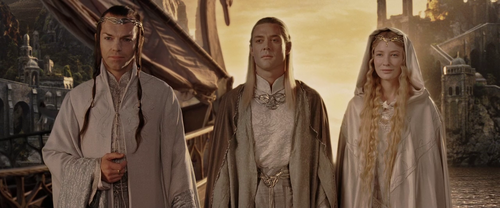
Tolkien had a simple view of good and evil. A good race, or rather an alliance of good (white) races…

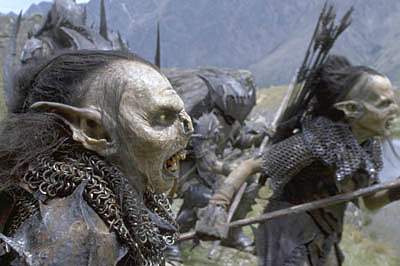
 have to defend their homes from an encroaching menace: the evil (dark) races.

By this world-view the enemy is utterly defeated when the leader is defeated. The battle between good and evil is fought between an army of each, with battle lines drawn, to the death. This is perhaps a view to be expected from a man who had experienced trench warfare; who had returned from the hell of chemical weapons to the bucolic surrounds of English pastoralism; who had seen all the power of industry turned to the destructive effort of war, and thus rejected industry as being itself destructive.

How could we, the modern readers, share this view? We are now more than a decade into the War on Terror. We have witnessed the fall of Sadaam, the killing of Bin Laden, Gaddafi murdered in a ditch by revolutionaries. We have seen Egypt fall and rise and fall again. Seen tyrants overthrown and replaced by corruption or chaos, have seen the empires of democracy spying on their own citizens. I cannot see a world in which good gathers its (white) people to its cause to defeat the encroaching evil (black) people. But that doesn’t mean that good and evil no longer battle.

Modern Fantasy does not show a world where evil is the ‘only game in town’. It shows a world in which the battle between good and evil takes place not between people, but within. Each character has good and evil within them, and each must allow that battle to be fought. In some evil wins, but not in all. Interestingly, the protagonists are seen by others as evil, perhaps even acknowledge that evil in themselves, but wish they could be better. The characters we hope to see succeed, Logan, Glokta, Shy, and yes even Jorg and Monza, (and why not throw Jaime Lannister in for good measure?) believe themselves to bad, but hope that they can be better. (For Jorg that hope comes late, and slow, and even as it comes he resists it – because he’s not one to be pushed – but it is there).

Sometimes these characters don’t achieve ‘goodness’; sometimes they are trapped by circumstance or history or any number of other forces, just as some good characters are corrupted, unable to maintain their goodness in the face of circumstance.
I want Glokta to succeed because I want for him the same thing he wants for himself, it’s just that he has given up on achieving it, while I hold hope. I want Logen to find peace because I want to believe that men can redeem themselves of past misdeeds, especially when those misdeeds weren’t entirely voluntary. I want Jorg to be a better person, because he’s not a very good person.
This isn’t to say that the battle between good and evil doesn’t take place. Many such battles are taking place, fought by independent splinter cells and sleeper agents, the battle-lines ill-defined and constantly shifting.

Which brings us to…

2. Fantasy is not just for boys.

It’s frustrating that this even needs to be said, but for Walter the success of evil he believes defines Modern Fantasy “says more about the psyche of the young male readers and writers who dominate grimdark fantasy than anything else.”

This is just so wrong-headed that I can’t even bring myself to invest much energy in the debate.
On Goodreads, the 5 star reviews for ‘The Blade Itself‘ include reviews from Maria, Kat, Inara, Annie, Faye, Sara and many other female readers. Likewise for ‘Prince of Thorns‘ we find Amanda, Rose, Natalie, Georgia, in the top dozen or so.
I could go on, but really – why bother.
As to only young men writing Modern Fantasy…
Ursula LeGuin, Robin Hobb, Trudi Canavan, Marion Ziommer Bradley, Janny Wurts, Anne McCaffery… of course JK Rowling. These authors aren’t mentioned as Grimdark, but I wonder if that’s because of how subjectively applied is the label. I do know that from my own experience in Australia I have met many talented women writing Fantasy and Spec-Fic. I struggle to believe that they are the exception.