This is the second in a series of reviews I am doing based on a reading-list which was inspired by Adrian Tchaikovsky’s proposal for a micro-sub-genre of Speculative Fiction which he has labelled Fantastical Realism. These are novels in which charatcers with low status or limited power inhabit a world (usually a city, usually in some state of early industrialisation) which is fantastical to us but mundane to its inhabitants, until the introduction of something new, or some changed condition, disrupts their world.
My first review in the series was of Tchaikovsky’s own City of Lost Chances.
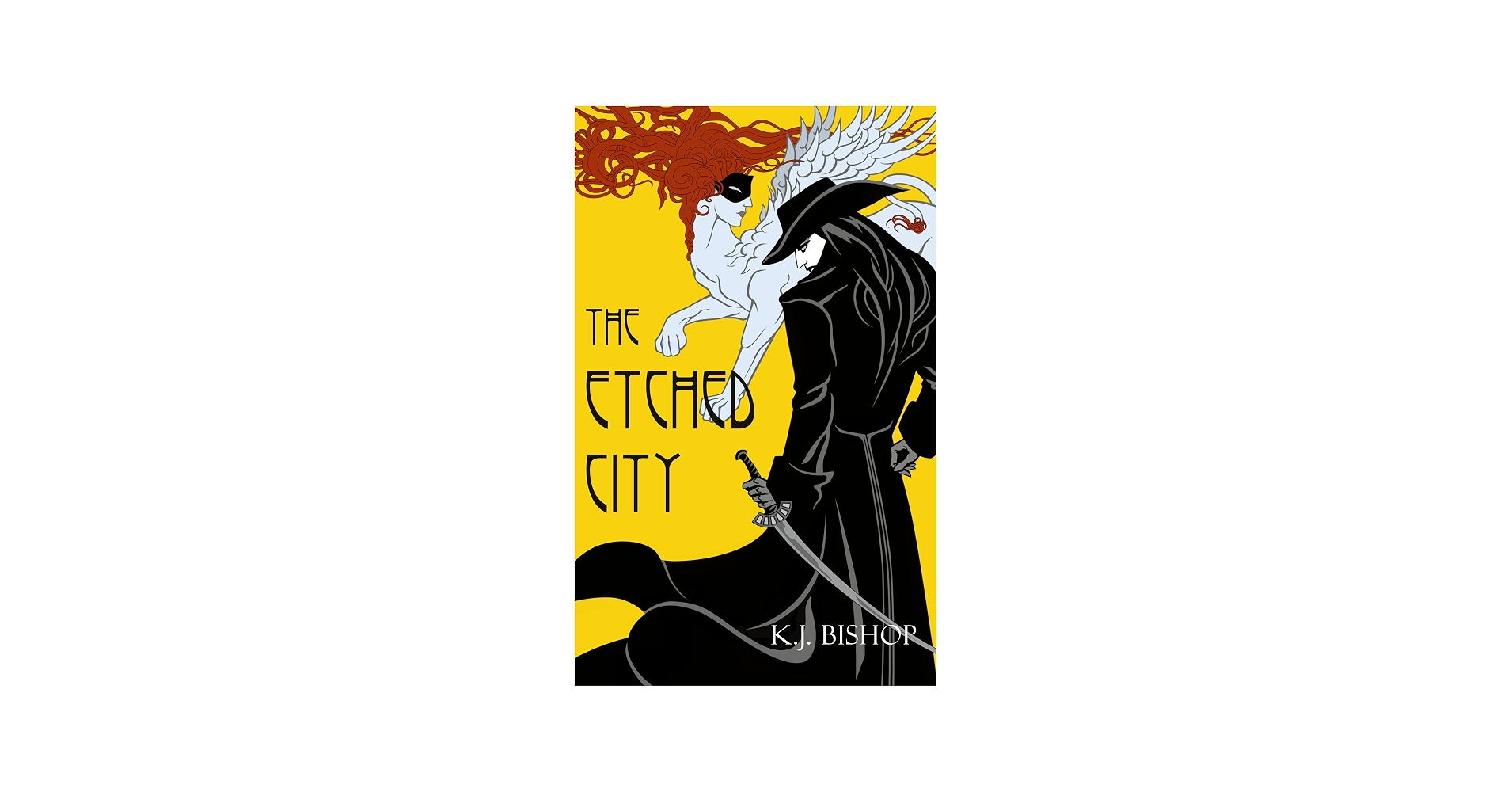
KJ Bishop is an Australian author (and fellow Melburnian). Published in 2003, The Etched City is her debut novel after she had previously been focussed on short fiction, and it was recognised with a nomination for the World Fantasy Award as Best Novel, and with the Ditmar Award for Best Novel, as well as Bishop herself being recognised with the Ditmar for Best New Talent.
I struggled with this novel, and I’m struggling with articulating my thoughts into a review of it. Like the novel iteslf, my thoughts on it are shifting and hard to pin down into the concrete.
Initially, I was taken in by the world Bishop described and the characters inhabiting it. We join Raule as she moves across the blasted desert-scape of Copper Country and its clear from the start that both the world and Raule herself have a rich history. We are joining her at this point in her story, but it has more the feel of a denouement than an opening. Raule had been a revolutionary in a failed revolution, and now, brought low, on the run, the climax of that story is already in her past. Her path intersects with Gwynn, a fellow-revolutionary and a former-colleague. They make an interesting pair, alike in many ways and opposed in others. Both capable of violence, though Gwynn is ruthless where Raule is methodical, Gwynn embraces the opportunity for violence where Raule accepts the necessity of it. Together, in an alliance more of circumstance than of conviction, they flee their pursuers as long as they can, before they inevitably need to make their stand.
The Copper Country setting has been described in other reviews as a blend between that American ‘Wild West’ and a mythologised ‘Arabia’ of bazaars and camel-trains. As an Australian reader it has more of the feel of the Outback to me, that vast interior of the continent in which red dust plains stretch horizon-to-horizon, towns spattered onto the landscape like bird droppings, and the ruins of colonial structures crumbling back into the sands. Other than the lack of cars, bikes and trucks, Copper Country could call to mind the backdrop of Mad Max.
With compelling characters in a complex relationship and an interesting landscape, and with the tension of the pursuit driving the narrative forward, this section of the novel drew me in and had me turning pages, but after the desperate stand against their pursuers, the novel takes a dramatic shift.
The second section of the novel, and the much larger bulk of it, take place far from Copper Country, in the city of Ashmoil.
A crumbling, shifting, decaying, vibrant, crowded city built on the banks of a broad river amid dense jungle, Ashmoil operates as a port for trade, a haven for criminals, a territorial battleground for gangs and a marketplace for art, drugs, guns, slaves, sex, and possibly for magic. That ‘possibly’ is there because Ashmoil is an ambiguous place, as the novel itself is ambiguous, and the line between potions and drugs is just as blurred and uncertain as the lines between claivoyant and charlatan, between mystic and mythology, between moral and immoral.
Raule finds work in a hospital among the city’s slums, acting as both nurse and midwife to the poor, using her war-time experiences of medicine to stitch up the wounds of the young knife-fighters after their ceremonial duels.
Gwynn finds work as a ‘cavalier’, a paid retainer for one of the city’s more successful crimelords. Part-mafioso, part-assassin, part-bodyguard, part-errand-boy. Always too well-dressed and well-mannered to be merely a thug, he spends many of his days in hedonistic pursuits: gambling, drinking, smoking, womanizing… a life of leisure punctuated by acts of violence.
Both are amoral in their work, though differently: Raule’s morality worn down to a nub by hardship and circumstance; Gwynn’s morality silenced by necessity and apathy.
Both are better trying to understand the city they inhabit: Raule through the study of the several deformed infants who die in the womb or shortly after their birth; Gwynn in his search for the artist who etched a cityscape in which Gwynn himself appears in the background.
I struggled with the early Ashmoil section of the novel because it is not plot-driven and I kept trying to find the plot. I kept trying to force the story to conform to my expectations, rather than allowing myself to discover the story as I went.
Oh, I this is a story of Gwynn’s search for an artist and the secrets he discovers when he reveals her? But it’s not that.
Oh, I this is a story about the mysterious cause of the birth defects, and how Raule finds a way to respond to that cause? But it’s not that.
I kept trying to find a clear protagonist and a clear antagonist, but found neither. Or perhaps found multiple. Or perhaps it is too reductive to approach the story in those terms. There is no overarching goal which the characters share, no central conflict to be resolved, or central question to be answered. Events occur and the characters respond or react. In some instances their lives are changed by these events, in other instances they continue on.
The middle of the novel is more a selection of sub-plots than a unified narrative. The main characters have little to do with each other, their stories running most often in parrellel with only a few moments of intersection, such as the corrupt priest who is both an administrator at Raule’s hospital and a theological/philosophical debating partner for Gwynn. One of Gwynn’s colleagues becomes obsessed with his employer’s songstress, Raule tries to help the mother of a young man she treats, a civil war is brewing and arms must be provided (to both sides and at great profit from each), the precarious balance of power between the crime families and the authorities shifts in ways that sometimes favour and sometimes threaten Gwynn’s employers…
I enjoyed the novel much more once I stopped trying to make it something it wasn’t. Once I accepted it as an examination rather than a narrative. A meditation on some big questions about morality and reality. Here is a city, and here are the lives of some people who inhabit it, and this is how they see their world and how they live those lives.
When Gwynn finds the artist, Bethine, who etched his image into her representation of the city, he falls (perhaps) in love and his deepening connection to her coincides with (or perhaps causes?) his own life and the city of Ashmoil itself to become increasingly fantastical. Both the novel and the city take on an ethereal, dream-like quality. It becomes increasingly difficult to distinguish the actual events of the narrative from dream sequences, drug trips and introspection. The character and nature of Bethine, and of the art she creates, are uncertain. It’s unclear if Gwynn is her muse or her subject, just as it is unclear whether she creates art from the city, or the city is created from her art, or the city itself is an artwork, or a dream, or an hallucination.
And in the final section of the novel, some of these various disjointed threads are stitched together into a final act. Or perhaps it is more apt to say that some of the story seeds germinate and propogate and blossom into a final act. Decisions are made. Overdue consequences belatedly arrive. Violence begets violence begets violence. Betrayal requires revenge. Some lives end in tragedy, others in sacrifice, others merely end, though death may not be the end it was believed to be. In mortal wounds, flowers bloom.
Few mysterious are solved, and the city–stranger now than it was when first introduced–is irrevocably changed.
This is one of those novels which embedded itself in my mind and which kept returning to my thoughts, unbidden, for many months afterwards. Fragments of images. The memory of scenes. Moments in the lives of the characters or in the city.
It is inventive and imaginative, excellently written and meticulously crafted. It fits very well into the subgenre Tchaicovsky proposes of Fantastical Realism.
Midway through I was expecting it would be closer to 3 Stars. Straight after I finished it I would have had it at a solid 4. Check back with me in the months or years to come and it may well be a 5.
Right now, as I complete this review: 4.5 Stars.
Would recommend to anyone who enjoyed Perdido Street Station and City of Last Chances, though with the caveat that it’s closer to the former than the latter, and more meandering and less structured than either.