Category Archives: Musings

From an idea to an act of creation

When I really should have been working on other things there suddenly popped into my head a line:

They rode out with the intent to kill Old Man Madigan, and the means to make it so.

This happens to me sometimes. Sometimes a line, sometimes a description, sometimes dialogue – even whole conversations. I use the notes function on my phone, or I scrawl this stuff on scraps of paper that I then keep in a completely chaotic and highly intuitive mess around my house, or occasionally in a notepad I bought, long ago, for the purpose.

And so this line about Old Man Madigan sat ignored for some time, until I came back to it and questioned what I had made. Who is/was this old man? Who was out to kill him, and why? why ‘riding out’?

Initially my answers to that were confused collisions of genre, or reductive allusions to things I’ve liked elsewhere. I wanted them a long way from authority, such that they had to take ‘justice’ into their own hands. I wanted to explore that ambiguity of authority, or its absence. I wanted to question whether these men seeking to deal death were agents of justice or of revenge. Was this a community coming together against a predator, or was this mob rule, unfettered in its attack on an outsider?

I liked the idea of a posse.

So the US perhaps? A western? Shane, or The Searchers? It made sense of the ‘riding out’, but it just didn’t grab me. A space western? Perhaps Joss Whedon’s fault. I could almost see Nathan Fillion sneering my line. Awesome… and yet not my own. The space thing was interesting though.
So they’re in space, a long way from Earth. Colonisers then? Something between LV426 and the Wild West writ extra-planetary? Barely more original than channelling Mal, but perhaps something I could work with. If I could steer clear of a Takeshi Kovacs analogue. No horses I suppose. Are they riding out on bikes? Hoverbikes?

I followed this path for a while. Researched light-speed, the fastest man-made objects, the nearest goldilocks planets. Nothing there unless I’m prepared to have spacecraft travelling up to percentages of light-speed  and even then the travel time is decades. So perhaps a moon, Saturn has plenty, Jupiter too, some potentially life supporting. But these men riding out should not be in space-suits. That’s not what I see. That doesn’t work for me.

Back to the notepad and disorganised filing then. For weeks. Months. I start writing other things. I’m in the middle of something that’s pretty hefty. Novella at least, perhaps room to grow. And then Madigan’s back.

Australia. Red dust. Post the exploration, pre-Goldrush. Madigan’s an impossible survivor from the prison fleets, fled or released upon his term and free now either way. He’s impossibly old, and the means of his longevity have earnt him the antipathy of the young community nearby his secluded home. He had fled other men, at least the white ones, but now the communities are growing, the Europeans spreading, and it has brought him into conflict. How? A young girl, missing, killed perhaps, perhaps used by this secluded old man. An angry father then, a community of angry fathers. The men of a fledgling town drawn together by their hatred and fear against Madigan, their common enemy.

But if Madigan is so long lived? Will he be so easily killed? What means do these men have? What assumptions do they make, and are they valid? And what is the role of the local inhabitants, considered fauna, shunned, ignored. What do they think of Madigan, what is he – this European interloper who will not die?

The images were coming thick and fast now. Red dust, hard men worn by weather and work, stern women with determined jaws, children casting off their parents’ culture for one all their own, the Aboriginal tribe, shifting and displaced, those caught in the middle – part of both worlds and neither…  and in this Madigan – a spider in its web. Or is he? Is he really the villain of the piece?

So I started writing. And suddenly I had 4,000+ words and a couple of thousand to come. A short story. Not yet born, but gestating nicely and not far off.

Excerpt here.


On corruption and salvation

I recently finished Chuck Wendig‘s ‘Double Dead‘. I liked it pretty well (full review later), and especially liked the concept: vampire wakes up and finds himself in the middle of zombie apocalypse. It seems so simple and obvious, and yet I can’t think of another example of it.

I got to the end and wanted to read more about Coburn, the vampire protagonist. As a character he really grabbed me, despite their being a pretty fundamental shift in the dynamic of his character in the final pages (I’m trying to keep this spoiler free – I will kinda hint at a few broad thematic points though, so there may be a bit of spoiler slippage. Sorry). It got me to thinking on how he had changed and what it was that still made him interesting to me, and I found it was quite a different kind of interest to that which had initially drawn me to the character and kept me there at his side throughout. And it set a nagging little question in my mind.

As a reader I seem readily to accept that people can be changed by a corrupting influence. I don’t think I’m alone or controversial here. Power corrupts, etc… but it’s more character relations I’m thinking of here. It seems utterly plausible that a basically good person can be brought low, can be turned to the dark-side, can be corrupted by the influence of an evil person. Grima Wormtongue in Lord of the Rings (seriously – don’t trust guys named ‘Wormtongue’ – rookie error), Emperor Palpatine – firstly on young Anakin and unsuccessfully on Luke, the corruption of Jack Torrance during his time at the Overlook, all these things we (or I) accept because it seems we (or I) believe / fear that there is an evil in all people, perhaps even within ourselves, a malevolence that must be kept in check, and which can be brought from us by outside influences. This is perhaps a negative view of humanity, but there you have it.

What I had a harder time accepting was the reverse, that an evil character, a nasty misanthrope, un-empathetic, revelling in his ways, could be redeemed by a character of pure goodness. In some small way I felt unsettled by this, not quite cheated, not really unfulfilled, but just that it seemed a little far-fetched.

And so having finished a book about a vampire in the zombie apocalypse, I’m left feeling that the ‘unrealistic’ part of the narrative was that a good person could influence and evil one to be better.

Is this just some deep underlying pessimism of mine? Or is it that we are more ready to accept the ‘gritty’ truth of corruption, and less prepared for the more optimistic process of salvation?


Genrecon 2013

Well people Genrecon’s inaugural event in 2012 was one of the highlights of my year and was a real kick-starter to help me get serious about the craft and business of writing. It introduced me to some wonderful writers at various stages of their careers, from fellow amateurs with an ambitious pitch to professionally published authors, self-published authors, agents, editors, publishers, international award winning best sellers. It had it all, and while it certainly fired my enthusiasm and drive it also opened my misted eyes to some of the harsh realities which lie behind the dreams of auctorial super-stardom.

So it is with great excitement that I receive the news that Genrecon 2013 is up and running. The start of the guest list was announced today and none other than Chuck Wendig is one of the International guests. I’ve mentioned his work and his website here before. I’m a big fan. When I came away from 2012 and thought about who would make a great guest for 2013 Chuck Wendig was right at the top of the list. I and several others tweeted as much at the time and if you don’t believe me check the records.

So what a year 2013. Neil Gaiman was here recently. China Mieville’s at Perth Festival (unfortunately I won’t get to go to see him, unless I make some irresponsibly hasty decision to skip work and fly across the continent).Apparently as part of the Supernovas and as side shows both Raymond E Feist and George R R Martin will be in Australia this year. It’s like my bookshelf come to life.

So check out Genrecon 2013 people, but not yet. Wait until I get in on the early bird special, then you can check it out.


On Cover Art and the Judging of Books Thereby…

At last year’s Genrecon one of the undoubted highlights was a snark presentation of covers given by Sarah Wendell of Smart Bitches, Trashy Books. Of course her particular focus was the Romance novels, an easy target perhaps for snarking, what with Fabio and man-titties (as opposed to man-boobs) and various other such tropes. It came to me though that Fantasy was as easily lampooned, the Hooded man, the enthroned King, the busty and poorly armoured warrior woman.

Covers are vitally important, despite the old adage that does not bear repeating. Perhaps in the ebook market this is less true, as opening a new ebook usually will take you to page one rather than to a cover, but with the flood of product a good cover is still an effective way to draw clicks to your Goodreads, or Amazon, or Kindle store presence.

I was surprised to hear from published authors how little control they had over the covers with which their novels appeared. I did here some anecdotes of cover artists communicating with the author, or perhaps even reading the book, but these were told as exceptions, remarkable precisely because they were not the rule. In some cases the author hated the cover which the publishers used.

Some years ago my sister recommended a book to me:

A-Game-Of-Thrones-George-RR-Martin-Book-Cover

This is (I think) the 1997 edition.

On the back cover, below the blurb, there’s an image of a white wolf running through the snow.

Here, I thought, is everything I hated about Fantasy.

The swordsman in black, the black warhorse, the snowy castle, the raven…

Could these images look more hackneyed and clichéd?

It looked terrible.

I read a chapter or so in case she asked me about it, then it was shelved.

Some years later I found this book in a book store:

AGoT_UK_Current

This is the 2003 edition under the Voyager imprint.

There’s a few extra endorsements, as over the intervening years and sequels Mr. Martin’s work had gathered a following and some rave reviews, but they’re mostly the same.

The blurb is much better on this than on the original, and I’m certain that that played a role in my selecting it too.

I bought it and began reading it without ever making the connection to the book my sister had given me.

It was only when I was several chapters into the book, and hooked, that I started to make connections with the earlier book I had shelved (or in fact, by that time, boxed-up and stored under the stairs).

For five years I had ignored a great Fantasy novel because of its cover.

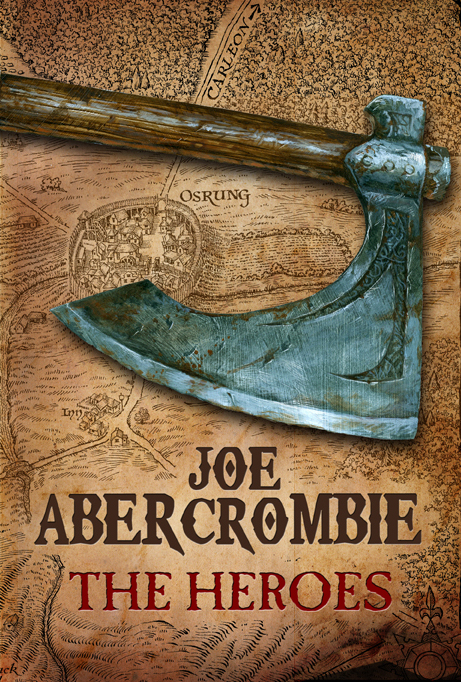
Another example of a cover leading me to great fiction is Joe Abercrombie’s The Heroes

The-Heroes-HB2front

I had a voucher to a bookstore sent to me as a Christmas gift, and I went in to buy China Mieville’s collection of short stories “Looking for Jake”, but I had some money left over and no real plan so I browsed the shelves.

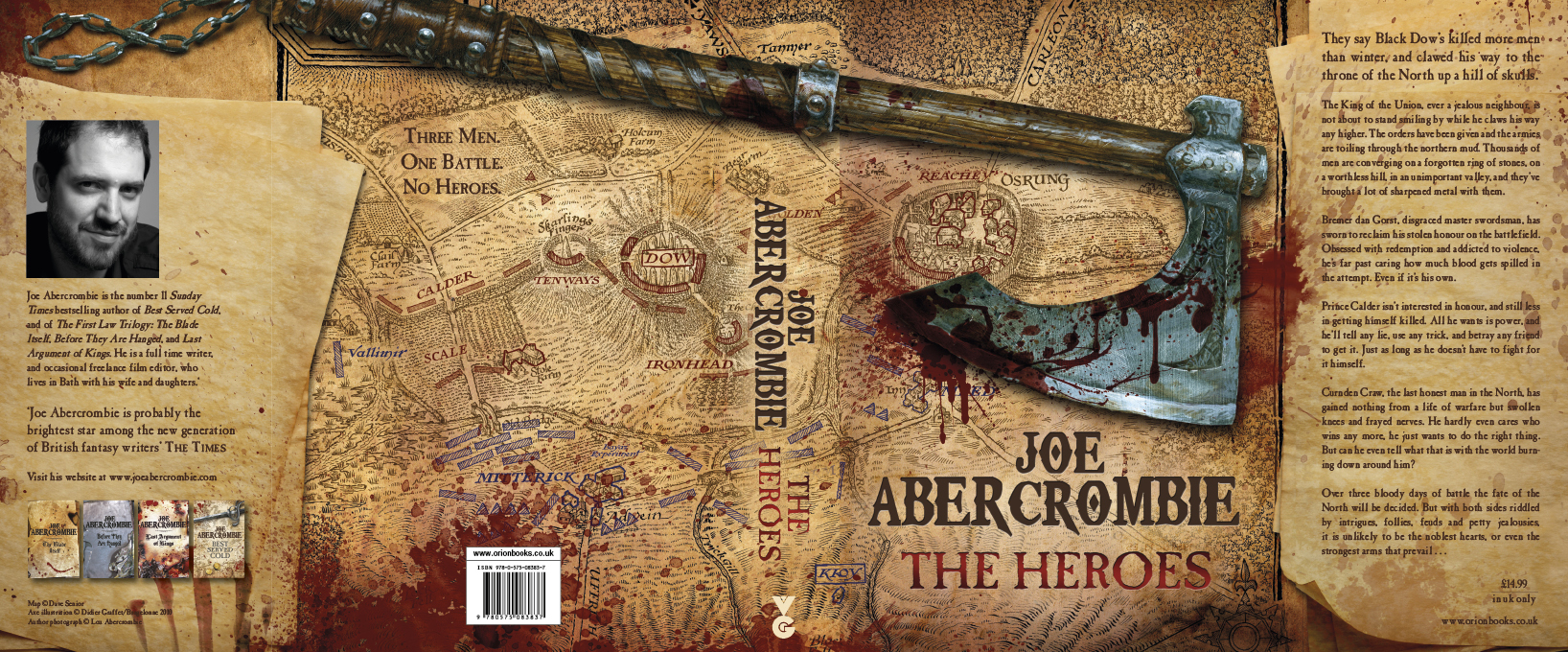
Abercrombie’s views on maps have been well explained, and he included none in his First Law trilogy (which also have great covers), but this cover (as with the covers for “Best Served Cold” and “Red Country”) manages to convey I think a very real sense of Abercrombie’s world and the style of Fantasy he writes.

I like them far more than the hyper-real close-ups of the US covers.)

I bought it, loved it, and went back through the First Law and “Best Served Cold” in a matter of weeks.

Here’s the jacket of Heroes in all its glory (click the image to enlarge):

The-Heroes-HB_jacket

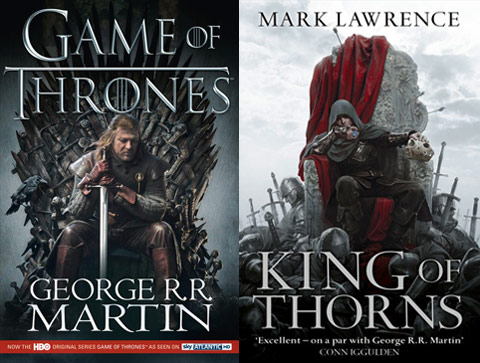
Recently the author Mark Lawrence responded to some suggestions comparing his cover for King of Thorns to GRRM’s Game of Thrones (specifically the Sean Bean cover that was released to tie-in with the success of the television series)

2013-01-03-book-cover-twins

Lawrence’s response was to refer to similar covers back through the history of genre and still being released:

Conan_the_LiberatorPromise_of_Blood
His point of course is well made. The mere similarity of having your protagonist (if Ned is the protagonist) sitting a throne is as much a part of Fantasy as the heroine swooning in the strong arms of her hunk is a part of Romance.

It’s always tempting of course to judge these covers. Whether they are examples of the best the genre has to offer, or some of the worst covers in the history of literature, there’s no denying their effect. It was suggested that the success of Fifty Shades of Grey in breaking beyond the Erotic Fiction market and into the mainstream was (in part) because it didn’t look like a typical Erotica cover.

It’s also worth acknowledging that the covers do not always reflect or represent the novel in the way the author would wish though, so in the interest of dispelling that hoary old cliche and admitting that of course we all do judge books in this way I invite you in the comments to nominate others.

What covers have made you pick up a book you went on to love?

What covers have drawn you to a book that you hated?

What covers have chased you screaming away swearing never to inflict such rubbish upon yourself… at least until they repackage it?


Next Big Thing

I was nominated as ‘The Next Big Thing’ by fellow Spec-Fic writer Chris Andrews (see his post here). The idea behind the nomination is that writers promote one another through our various networks and blogs, and so it falls to me to answer the questions below.

You may wish to head over to Chris’ blog and have a look around, he’s been doing this a while longer than me I feel and has some really interesting resources on his planning process and novel writing. Far more organised than my general musing and occasional update of progress.

But I digress…

1) What is the working title of your book?

It’s currently going under the title of Exile. I like the idea of a shorter title, and I like the idea that ‘exile’ functions as both noun and verb, that as a noun it can apply to a person or a condition or perhaps even a place.

2) Where did the idea come from for the book?

It has changed so much since it was first conceived that I’m not sure that I can answer the question well. I didn’t think so at the time of writing, but looking back I suspect it may have come from the experience of my own family’s circumstances. When I started writing I had a very clear idea of who the main character would be, but I’ve drifted away from that, perhaps as I’ve matured, and it’s more an ensemble piece now.
It draws from my studies of history and the Classical world. I kept wondering how different historical cultures would have reacted if they ever were to have met. I also wanted to explore the social contract we enter into, that decision to submit to an authority and the assumption that the authority will act in your interests, or at least not directly against them. I’m interested in how that social contract is currently functioning in various cultures, and I wanted to explore how it functioned in a Fantasy setting.

3) What genre does your book fall under?

It’s Fantasy, but that’s not really specific enough is it? When I describe it to others they use the term Epic Fantasy. I’m not sure I’m comfortable with that. Certainly I think there is an epic back-drop in terms of the scale of the world-building.  The plot is influenced by inter-continental events, the clash of great powers, and yet that’s not the focus. It’s not about the saving of worlds, or the shaping of history through great deeds and prophecies fulfilled, and I think to be Epic Fantasy these are pretty important.

Low Fantasy then perhaps, but not quite as dark as Abercrombie, Morgan, Lawrence et al.

4) What actors would you choose to play the part of your characters in a movie rendition?

I have deliberately avoided thinking in these terms. In many ways because if it ever were to be made into a film that future is so distant and unlikely that references to current Hollywood stars would be meaningless.

So I would choose up-and-comers. I would (given my ‘druthers) avoid the star-powered path. That said, I think there’s a part in there for Djimon Honsou and for Chiwetel Ejiofor or Idris Elba. Cristoph Waltz almost certainly. Stellan and Alexander  Skarsgård. Probably more European actors than American.

5) What is the one-sentence synopsis of your book?

When three siblings are separated by a conflict they cannot control, each must adapt to a new life, and perhaps find a way to thrive.

6) Will your book be self-published or represented by an agency?

I have pitched to an agent, who requested pages, so the process is under-way. I’m thinking the agent to publishing path is my preferred, so I’ll try and exhaust that possibility before looking too closely at others.

7) How long did it take you to write the first draft of the manuscript?

This is another interesting question. I started writing the manuscript that would become this manuscript about 15 years ago. That’s not to say I’ve spent 15 years writing it though. I wrote as a hobby, when I could. I had only the most nebulous dreams of one day being a ‘writer’ and I didn’t ever think I would reach the point of having a manuscript that might interest anyone else. That original writing has changed so much, been rewritten so often, been so edited that very little of it survives in the current manuscript.

I’ve been seriously working to make this a novel for the last 12 months or so.

8) What other books would you compare this story to within your genre?

I’ve mentioned a few. I’ll use the usual suspects and some new-comers as landmarks and maybe place myself that way:

Not as stolid as Tolkein, not as genealogical as GRRM, less graphic sex than Richard Morgan, less bleak then Abercrombie. Not as weird as Bas-Lag. Not as dense as Viriconium. Not as overtly allegorical as Dune.

9) Who or what inspired you to write this book?

The foremost influence was Feist’s  ‘Magician’ I think, at least initially. It wasn’t the first Fantasy novel I had read but it was the first time I had read a novel and seen the constituent parts that built the story. I think it stands as an excellent example, perhaps the prime example, of what it is. I cannot think of a Bildungsromanin the Fantasy genre that does it quite so well. It also opened up the idea of non-European cultures in Fantasy, and of those cultures being something more than the indistinctly drawn enemy. It seems that Feist will use Tsurannuani this way, and yet there’s that scene where he gives us their POV: We see the characters we’ve followed as they saved Crydee and we see them as a respected enemy, and from there of course we learn about the fractured nature of the Tsurani and their internal political disputes.

From that point, that I decided I could write a novel, I drew inspiration from many places. From history’s many tales. From Chaucer’s Middle English, Anglo-Saxon poetry, medieval bestiaries, the eddas and sagas, the myths of India and Africa, the common human myth identified and explained by Joseph Campbell.

10) What else about the book might pique the reader’s interest?

What indeed. I suppose that depends on the reader.

A huge secondary world with a living history?

Fallible characters who err and face the consequences, who are uncertain, who lack-confidence or over-commit, who cannot rely on divine prophecy or enchanted trinkets?

Political intrigues played out in the chambers and courts of nobility?

Bloody battles played out in the mud, ringing with the cries of warriors and the clash of spear on shield?

Forests filled with strange beasts?

Death, love, betrayal, suspicion… all the confused emotions that from people trying to find their way toward the life they wish to lead.

And my recommendation for the ‘next big thing’?

Richard Marek, whom I knew online long before I met him (recently – at Genrecon), and has shown me some of his work and I sincerely hope he  continues with his efforts to publish.